




When it comes to RVs, everyone knows the truck camper reigns supreme for boondocking, off-road travel, and reaching remote campsites. But before you buy one, it’s important to understand the key differences between hard-side and pop-up truck campers. Each has distinct advantages and disadvantages, and choosing the right one ultimately depends on how and where you plan to travel. In this article, we’ll compare the strengths and weaknesses of both styles so you can make a more informed buying decision.
So which type of truck camper is better? That’s a great question—and one that’s been debated for years. Years ago, we were asked to write an article on this hotly contested topic. Having owned only hard-side campers at the time, however, we chose not to because we didn’t feel qualified to make a fair comparison. How could we honestly compare the two without having owned a pop-up? That all changed with the recent purchase of a Four Wheel Camper Grandby. Now that we’ve traveled and camped extensively in both types of campers, we can finally share our firsthand opinions on the pros and cons of each.
Of course, buying a camper ultimately comes down to personal preference. Not everyone wants to travel in a large, palatial triple-slide truck camper. Some prefer to travel light and nimble, while others enjoy the comfort and amenities that come with a larger rig. What kind of roads do you plan to explore? What seasons will you be camping in? Will you be towing a trailer or another vehicle? Like most things in life, it all comes down to what’s most important to you at this stage in your adventures. So without further adieu, let’s take a look at the pros and cons of hard-side and pop-up truck campers.

Hard-Side Truck Camper Pros
The hard-side truck camper offers a number of advantages. The most obvious is the sheer number of makes and models available today. There are far more hard-side campers on the market than pop-ups, and that holds true in both the new and used markets. At present, the big three—Lance, Northwood Manufacturing, and Host—offer a combined total of 24 full-size models. Some are designed for short-bed trucks, while others are built for long-bed pickups. Many also feature one or more slide-outs, something you simply can’t get with a traditional pop-up.
If luxury is high on your priority list, it’s hard to beat a hard-side camper. Models like the Host Yukon 11.6 and Rugged Mountain Denali 3S XL offer amenities rarely found in any RV of this size, including recliners, fireplaces, kitchen islands, massive battery banks, and expansive living areas. Their interiors are so spacious and well-appointed that it’s easy to forget you’re sitting in the bed of a pickup truck.
That brings us to another major advantage—size. In general, hard-side campers offer significantly more living space than pop-ups. That’s due not only to their longer floorplans—some stretching to 12 feet—but also to the addition of slide-outs, which dramatically increase interior room. The living space found in triple-slide campers like the Mammoth and Denali rivals that of many Class C motorhomes. Higher sidewalls also allow for larger cabinets, roof lockers, and additional storage throughout the camper.

One of the biggest conveniences is the bed. In a hard-side camper, it’s always ready to use. There’s no need to raise the roof before climbing in for a quick nap or stretching out during a roadside lunch break. It’s a small convenience that becomes a big one after a long day behind the wheel.
Looking for more amenities? Hard-side campers shine here as well. While many pop-ups include a wet-bath with a toilet and shower, they tend to be much smaller. Many hard-side campers feature spacious dry baths along with substantially larger fresh, gray, and black water holding tanks. The Rugged Mountain Denali 3S, for example, currently boasts an impressive 82 gallons of fresh water. Yes, Outfitter’s Apex and Juno pop-ups offer an outstanding 44 gallons of fresh water—which is remarkable for a pop-up—but overall, hard-side campers remain the clear leaders in holding tank capacity for extended boondocking. They also provide more factory-installed air conditioning options, including both AC- and DC-powered units.
Looking for a true four-season truck camper? In general, the hard-side is the better choice. While some hard-side models are designed primarily for three-season camping with exposed holding tanks, nearly every manufacturer offers four-season models. These campers typically feature higher insulation values in the roof, walls, floor, and ceiling, heated holding tanks and water lines to prevent freezing, and insulated dual-pane windows. Among the best four-season manufacturers are Adventurer Manufacturing, Kingstar, Bigfoot, and Lance.
Another advantage of a well-insulated hard-side camper is a quieter interior. Hard walls do a much better job of blocking wind, rain, and outside noise while also providing greater protection from wildlife. In fact, several national parks and campgrounds in bear country prohibit soft-sided campers, making a hard-side the only option in certain areas.
So to recap, here are the pros of the hard-side truck camper:
- Greater selection
- Larger floorplans and more living space (slide-outs)
- Larger holding tanks
- More storage
- More air conditioner options
- Full-time bed
- Larger electrical systems (batteries and solar)
- Better facilities (toilet and shower)
- Better protection from bears
- Better insulated, quieter
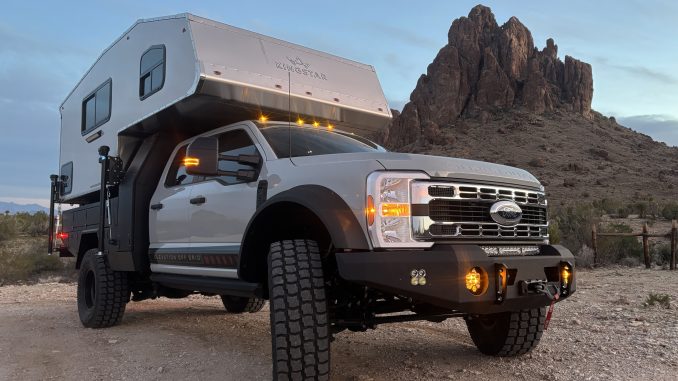
Hard-Side Truck Camper Cons
As great as the hard-side truck camper is, it does have a few drawbacks compared to a pop-up. The biggest is its size and weight. Being larger and heavier creates more wind resistance on the highway, which usually translates into lower fuel economy. The two go hand in hand, but wind resistance deserves special mention because it can literally become a drag when driving in strong crosswinds or passing semis. If you’ve ever experienced a white-knuckle drive on the Interstate during a windy day, you know exactly what we mean. The taller and heavier the camper, the more you’ll notice it—and the more often you’ll find yourself stopping at the fuel pump.
Weight also means you’ll need a truck with greater payload capacity. We’ve written extensively about GVWR and payload here at Truck Camper Adventure, so we won’t dive too deeply into the subject again, but it’s an important consideration. Many of today’s hard-side campers—particularly those with slide-outs—require a one-ton dual-rear-wheel truck for adequate payload and stability. Some owners have even stepped up to Class 4 trucks like the Ford F-450 or Class 5 trucks like the Ram 5500 to safely haul today’s largest and most luxurious double- and triple-slide campers. The lightweight hard-side models from Scout are a notable exception, but they are just that—an exception.

The larger size of a hard-side camper also makes onsite storage more challenging. If you have a large piece of property, finding room probably won’t be an issue. But for those living in neighborhoods with strict HOA rules or limited driveway space, storing a truck camper can become a real concern. Keeping your camper protected from the sun and weather is one of the best ways to extend its life, which means you’ll ideally want to store it under cover. That may require purchasing a home with an RV garage or investing in a large RV carport or enclosed storage building.
Finally, there’s the matter of cost. In general, hard-side campers are more expensive than pop-ups, although larger manufacturers like Lance and Northwood Manufacturing are often able to keep prices more competitive through higher production volumes. Even so, inflation has pushed many hard-side campers well beyond the reach of the average buyer. It’s not uncommon for today’s slide-out models to exceed $80,000, while a well-equipped non-slide hard-side camper can still be purchased for around $40,000. As always, it comes down to your budget and deciding which features matter most to you.
So to recap, here are the cons of the hard-side truck camper:
- Poor fuel mileage
- Heavier (requires a higher-rated truck)
- Greater wind resistance
- More expensive
- Harder to store (requires more space)

Pop-Up Truck Camper Pros
If your adventures regularly take you off the beaten path, nothing beats a pop-up truck camper. A capable four-wheel-drive truck is certainly important, but without an equally capable camper, you’re still limited in where you can go. What makes the pop-up such a great choice? It all comes down to one thing—its low profile.
That lower profile creates less wind resistance, which translates into better fuel economy and fewer stops at the gas pump. Some owners report fuel economy of 18 mpg or better while hauling a pop-up. Just as important, the lower center of gravity makes the camper feel more stable on rough terrain and narrow backroads. A pop-up can squeeze under low-hanging tree branches, beneath rock overhangs, and through tight forest trails that would stop many hard-side campers in their tracks. The bottom line? When it comes to serious off-road travel, there’s simply no more capable truck camper than a pop-up.
The pop-up’s lighter weight and lower cost are two more significant advantages. Depending on its size and construction, today’s pop-up campers typically weigh between 800 and 1,500 pounds. That allows many models to be carried by mid-size pickups like the Toyota Tacoma and lighter-duty full-size trucks such as the Ford F-150. Their smaller size and simpler construction also make pop-ups more affordable than most hard-side campers, although prices vary depending on the manufacturer, materials, and included features.

Storage is another area where the pop-up shines. With the roof lowered, many pop-up campers fit inside a standard residential garage—something that’s simply impossible with most hard-side campers. For many owners, that’s a huge advantage. One reader summed it up perfectly: “Why a pop-up? It’s lightweight, has a low profile and low windage, fits under most bridges and trees, and even fits under the sun shade on our side yard.”
While there are far fewer pop-up truck campers on the market than hard-side models, buyers still have plenty of excellent choices. Nearly a dozen manufacturers currently build slide-in pop-up campers. Industry leader Four Wheel Campers offers nine models, Phoenix Campers builds five semi-custom designs, and Overland Explorer Vehicles (OEV) produces 10 truck camper models, including both hard-side and pop-up designs, along with several chassis-mounted campers. BundutecUSA also offers nine pop-up models, although they are built in smaller numbers with a greater emphasis on customization.
Some of our favorite pop-up campers include Outfitter’s outstanding Apex 8, Supertramp’s Flagship LT, and the BundutecUSA Wild. Even Scout has joined the movement, introducing its own line of innovative pop-up truck campers in response to the growing demand for lightweight, off-road-capable RVs.
So to recap, here are the pros of the pop-up truck camper:
- Lighter (can be hauled by lower-rated midsize and full-size trucks)
- Better fuel mileage
- Easier to drive (less wind resistance)
- Better off-road capability (lower center of gravity)
- Lower profile (can go where few RVs can)
- Less expensive
- Easier to store at home or in a storage facility

Pop-Up Truck Camper Cons
So what are the downsides of a pop-up truck camper? There aren’t many, but the ones that do exist are worth considering. The biggest is that the roof must be raised before you can fully use the camper. Whether the roof is lifted manually or electrically, it’s an extra step that adds a little time to every roadside stop and campsite setup. While it only takes a minute or two, it’s something to keep in mind if you’re making frequent stops throughout the day. The pop-up is also less stealthy. Once the roof is up, it’s obvious someone is camping inside.
Pop-up campers are generally smaller as well, which means less living space and fewer options for entertaining family and friends. You won’t find large dry baths in a pop-up, although many models offer well-designed wet-baths with cassette or portable toilets. Pop-ups also provide fewer air conditioning options than hard-side campers. While many manufacturers now offer compact DC air conditioners, they require a substantial battery bank to operate for extended periods—something many pop-ups simply don’t have, as one or two 100-amp-hour batteries remains the norm.
The soft-wall design brings a few additional compromises. Without solid walls, there’s less room for upper cabinets and overhead storage, although several manufacturers have done an excellent job of maximizing storage with roof lockers, under-bed compartments, raised-floor storage, and other creative solutions.
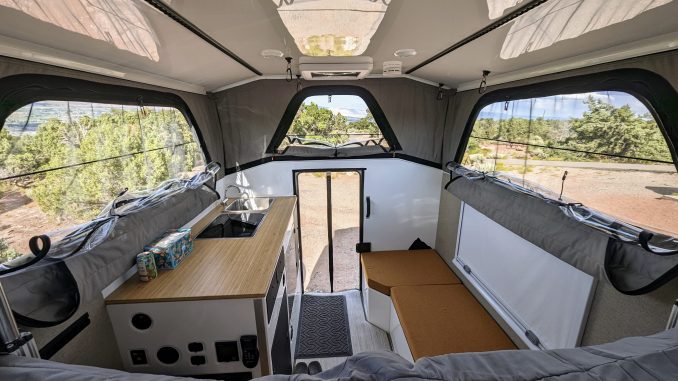
If winter camping is on your agenda, you’ll also want to consider the lower insulation value of the soft walls and the additional propane or diesel required to keep the camper warm. Fortunately, many manufacturers now offer insulated liners that attach to the soft walls with Velcro, dramatically improving cold-weather comfort. They don’t completely eliminate heat loss, but they make a noticeable difference.
Soft walls also allow more outside noise into the camper. We noticed this firsthand while attending a Four Wheel Campers rally and were surprised by just how much we could hear from neighboring campsites. If you’re a light sleeper, a good set of earplugs can make a world of difference.
Finally, if you camp in rainy conditions, you’ll need to make sure the soft top is thoroughly dried before storing the camper. Folding the roof down while the fabric is still wet can lead to mold and mildew if it isn’t reopened and allowed to dry as soon as possible.
One final consideration is wildlife. If your travels take you into bear country, remember that many campgrounds and national parks restrict or prohibit soft-sided campers. If hunting, fishing, or backcountry camping is part of your travel plans, this is an important limitation to keep in mind.
So to recap, here are the cons of the pop-up truck camper:
- Smaller (less living space)
- Roof must be raised before use (manual or electric)
- Less interior storage
- Smaller electrical systems (batteries and solar)
- Less stealthy
- Noisier inside
- Less insulation in extreme weather
- Soft top should be dried after rain
- Restricted camping in some bear areas

Final Thoughts
So, which type of truck camper is better? After weighing the pros and cons of each, the answer really depends on your camping style, your priorities, and where your adventures take you. Neither design is objectively better—they simply excel in different areas.
Your truck, of course, will play a major role in your decision. If you already own a pickup, its payload rating will largely determine which campers are suitable. For example, if you have a lower-rated truck powered by a V6 or small gasoline V8, a pop-up may be the better choice thanks to its lighter weight, lower profile, and reduced wind resistance. On the other hand, if you own a capable one-ton or higher-rated long-bed truck, you’ll have a much wider selection of hard-side and pop-up campers to choose from.
It’s also worth thinking about the kind of camping you enjoy most. If your goal is to tackle rugged backroads, navigate tight forest trails, and explore remote destinations, a lightweight pop-up is hard to beat. But if you spend weeks on the road, value interior comfort, or frequently camp in cold weather, the extra space, larger holding tanks, and superior insulation of a hard-side camper may make it the better fit.
The good news is that there isn’t a wrong choice. Both styles offer incredible freedom and the ability to camp in places that many other RVs simply can’t reach. Whether you choose a hard-side or a pop-up, you’ll be joining one of the most versatile and capable segments of the RV world.
Of course, if you’re still having trouble deciding between the two, there’s always another option—buy one of each. That’s exactly what we did, and we haven’t looked back since.
Like we always say, “What’s better than one camper? Two campers!”





Good article, but I’m a dedicated Pop-Up guy with a Northstar 850SC. On the Pro Pop-Up side one important plus is never mentioned. With the top up I have a complete 360 view of my territory and if needed a complete 360 ventilation option. I love to see all around me out in the Boondocks and the hard sides I’ve looked at have only about 25% of the view I have! Scott
In the Pros/cons there are a couple more considerations you forgot .
First is refrigerator size. The pop up limits the amount of height available for a refrigerator so most popups top out around a 4cuft refrigerator while it isn’t unusual to find a 6cuft absorption or 8 cuft compressor refrigerator in a Hard Side. 2-4 cuft makes the difference between Beer OR Food vs Beer AND food in the refrigerator.
Second is oven types The additional top mounted storage in a hard side allows both a microwave/convection oven in addition to a propane oven while most pop ups only provide one or the other due to the space constrains. While many only care if they have one or the other it is nice to have the option for both that the hard side more often provides.
The wife and I have had everything between backpacks w/wo tents or tarps to big Class A motor homes throughout our 52 years together. It really does depend upon one’s desires at any particular time in life and budget. We have immensely enjoyed all of our “RVs” and currently have a twin slide Lance on a K3500 dually and a ’99 TJ toad. We realize and appreciate what we have (and have had) to not be afraid of change. Our desire is to keep going forward for as long as our health allows us and use whatever means necessary to do so.
I love that approach.
There are only four camper categories that matter.
1: Pooping outside Camper.
2: Pooping inside Camper, in full view of your wife with full smells.
3: Pooping inside Camper out of view but still with smells.
4: Pooping inside Camper out of view and nearly no smells.
All other categories are meaningless.
🤣👍
I owned a Northern Lite 8.11 for a number of years and am surprised you did not mention it when talking true four season hard side campers. They are truly the best in this category in my experience.
The camper got me off grid but not that far off grid. I was constantly loading and unloading it to go camping. It was a high quality camper that we thoroughly enjoyed while we had it.
Two weeks ago I ordered a Four Wheel Camper Hawk slide in model and can’t wait to get it. I plan on leaving it on my F350 full time so I am ready to go at a moments notice to the mountains, my favorite fly fishing locations, hunting spots, photography locations or just a simple get away for a night up on the mountain.
It will take me places I could never get to with my Northern Lite and while I will be giving up some luxuries, the FWC will have everything I need. I can’t wait for it to be built!
Alaskan Campers offer the best of both worlds — hard sided pop up.
They are the best campers ever.