




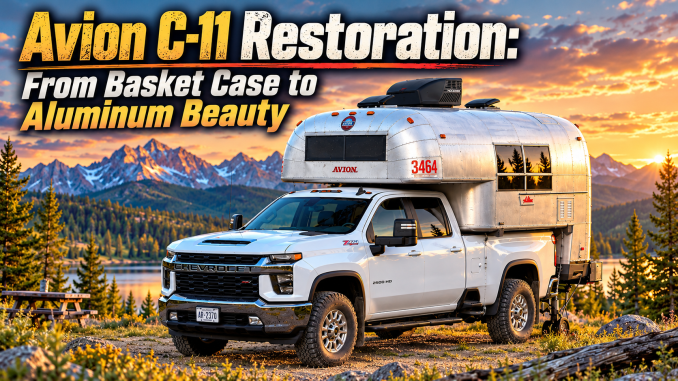
More than 1,000 rivets, a completely rebuilt interior, and a pair of very different Chevy trucks have given this vintage aluminum camper a new lease on life.
Some truck campers are built for adventure. Others become adventures long before they ever leave the driveway.
For Brian Uerling, restoring a 1968 Avion C11 turned into a project that combined two lifelong passions: classic trucks and the great outdoors. What started as a supposedly mint-condition camper purchased on Facebook Marketplace eventually became a major restoration involving structural repairs, a new floor, modern electrical and plumbing systems, and more than 1,000 rivets.
The finished product is something special. From the outside, Brian’s Avion retains the unmistakable aluminum aircraft-inspired styling that made these campers famous. Inside, however, it’s an entirely different story. Nearly everything has been rebuilt, refurbished, or replaced with modern equipment.
And the trucks carrying this aluminum classic? They’re almost as interesting as the camper itself.
One is a 1975 Chevy C30 affectionately named Colonel Mustard, powered by a transplanted Cummins diesel and backed by a six-speed manual transmission. The other is a modern 2022 Chevrolet Silverado 2500 equipped with the 6.6L gasoline V8.
We recently caught up with Brian to learn more about his remarkable restoration, the challenges he encountered along the way, and why he believes getting out and camping is far more important than having the perfect rig.

A Vintage Camper with an Airplane Pedigree
Brian has always had a soft spot for old vehicles.
“I’ve always had a passion for old cars and trucks and have restomodded several over the years,” he explained. “I also love spending time outdoors, so finding a camper that brings both of those passions together has been the perfect fit.”
For those unfamiliar with the term, a restomod combines restoration with modernization. Rather than returning an old vehicle or camper to exact factory specifications, the goal is to preserve its original character while upgrading the mechanical systems, equipment, and amenities that make it more enjoyable to use.
That’s exactly what Brian had in mind when he started looking for a vintage truck camper.
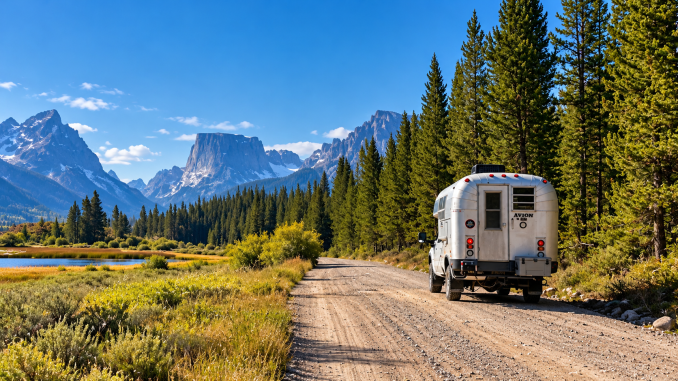
His choice was a 1968 Avion C11, one of the most recognizable truck campers ever produced. With its rounded aluminum body, distinctive riveted construction, and aircraft-inspired appearance, the Avion is a rolling reminder of an era when campers were built to last.
“I’ve always admired Avions for their all-aluminum construction and aircraft-inspired design,” Brian said. “They’re tough, timeless, and they just stand out compared to anything else on the road.”
For someone who enjoys restoring classic vehicles, the C11 was an obvious choice.
There was just one problem.
The camper wasn’t quite what the seller claimed.

Facebook Marketplace’s Definition of Mint Condition
Anyone who has purchased an old vehicle online knows that the words mint condition should sometimes be taken with a grain of salt.
Brian’s Avion was no exception.
“I found it on Facebook Marketplace, listed as being in ‘mint condition.’ It wasn’t,” he recalled.
That might be putting it mildly.
At some point in the camper’s history, a previous owner had installed a window air conditioner in the driver’s side of the cabover. Rather than carefully engineering the installation, the owner simply cut an opening through the aluminum body—and through a structural member.
The result was an eyesore that also compromised the camper’s strength.
Brian knew it had to go.
His first major repair involved removing the air conditioner, rebuilding the damaged structural area, and installing new aluminum skin to restore the camper’s original appearance.
With that problem solved, Brian and his family enjoyed the camper for a couple of seasons.
But the Avion wasn’t finished revealing its secrets.
Eventually, Brian decided to replace the floor and wings—the structural sections extending along the sides of the truck bed. What he thought would be a relatively straightforward repair quickly grew into something much bigger.
“That opened up a can of worms,” he said. “The deeper I went, the more I discovered that needed attention.”
Sound familiar?
For anyone who has restored an older truck camper, those words probably bring back a few painful memories.
A Thousand Rivets and a Whole Lot of Patience
Once Brian committed to the restoration, there was no turning back.
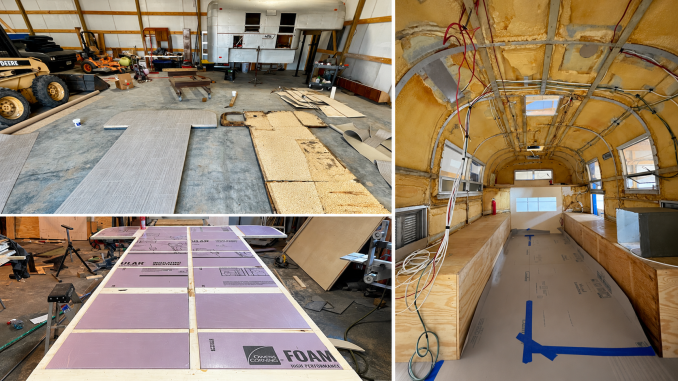
He began by carefully removing the components he hoped to reuse, including the cabinetry and interior aluminum liner panels. The original wings were removed intact so they could serve as templates for the replacements.
After installing the new wings, he braced the camper’s structure and turned his attention to the floor. The original floor provided the pattern for the new one, and Brian installed fresh vinyl sheet flooring before reassembling the structure.
Next came the front wall, followed by the tedious work of patching holes and sealing unnecessary openings in the aluminum exterior.
And then there were the rivets.
Lots and lots of rivets.
Unlike a conventional wood-framed camper, an Avion’s aluminum construction requires a different approach to structural repairs. Brian enlisted his brother to help with the riveting process.
“My brother helped with riveting—he held the buck on the inside while I used the air hammer on the outside,” Brian explained.
By the time the exterior repairs were finished, Brian had installed more than 1,000 rivets.
That’s a remarkable amount of work, especially when you consider that each rivet required access to both sides of the aluminum skin.
With the structural repairs completed, Brian moved on to the camper’s interior.
All-new electrical wiring and plumbing were installed, and the existing spray-foam insulation was touched up where needed. The aluminum interior liner panels were then reinstalled and painted.
Rather than discard the original cabinetry, Brian refurbished it, installing new cabinet doors and drawer fronts to give the interior a fresh appearance without losing its vintage character.
Of course, a few changes were necessary to accommodate modern appliances and Brian’s preferred style of camping.

A Smarter Kitchen with More Storage
One of the more interesting changes to Brian’s Avion was the elimination of the original propane stove.
For many truck camper owners, removing the indoor cooktop might seem like an unusual decision. For Brian, however, it made perfect sense.
Most of the family’s cooking takes place outdoors using a portable Coleman camp stove. By eliminating the built-in stove, Brian gained valuable counter space and room for another storage cabinet.
The Coleman can also be brought inside when the weather doesn’t cooperate, provided it’s used with appropriate ventilation and indoor-use precautions.
The refrigerator received a major upgrade as well.
Gone is the original propane absorption refrigerator. In its place is a larger 12-volt compressor model, which required Brian to modify the surrounding cabinetry.
The result is a more practical kitchen that better matches how the family actually camps.
It’s also a good example of what makes a restomod different from a traditional restoration. Brian wasn’t trying to recreate the camper exactly as it left the factory. He was making it more useful for the way he travels today.

A Bathroom Rebuilt from the Floor Up
The bathroom received some of the most thoughtful modifications in the entire project.
Rather than retain the original blackwater holding tank, Brian eliminated it and installed a portable Thetford toilet.
The toilet can be moved outside temporarily when someone needs to use the shower, freeing up valuable floor space in the compact bathroom.
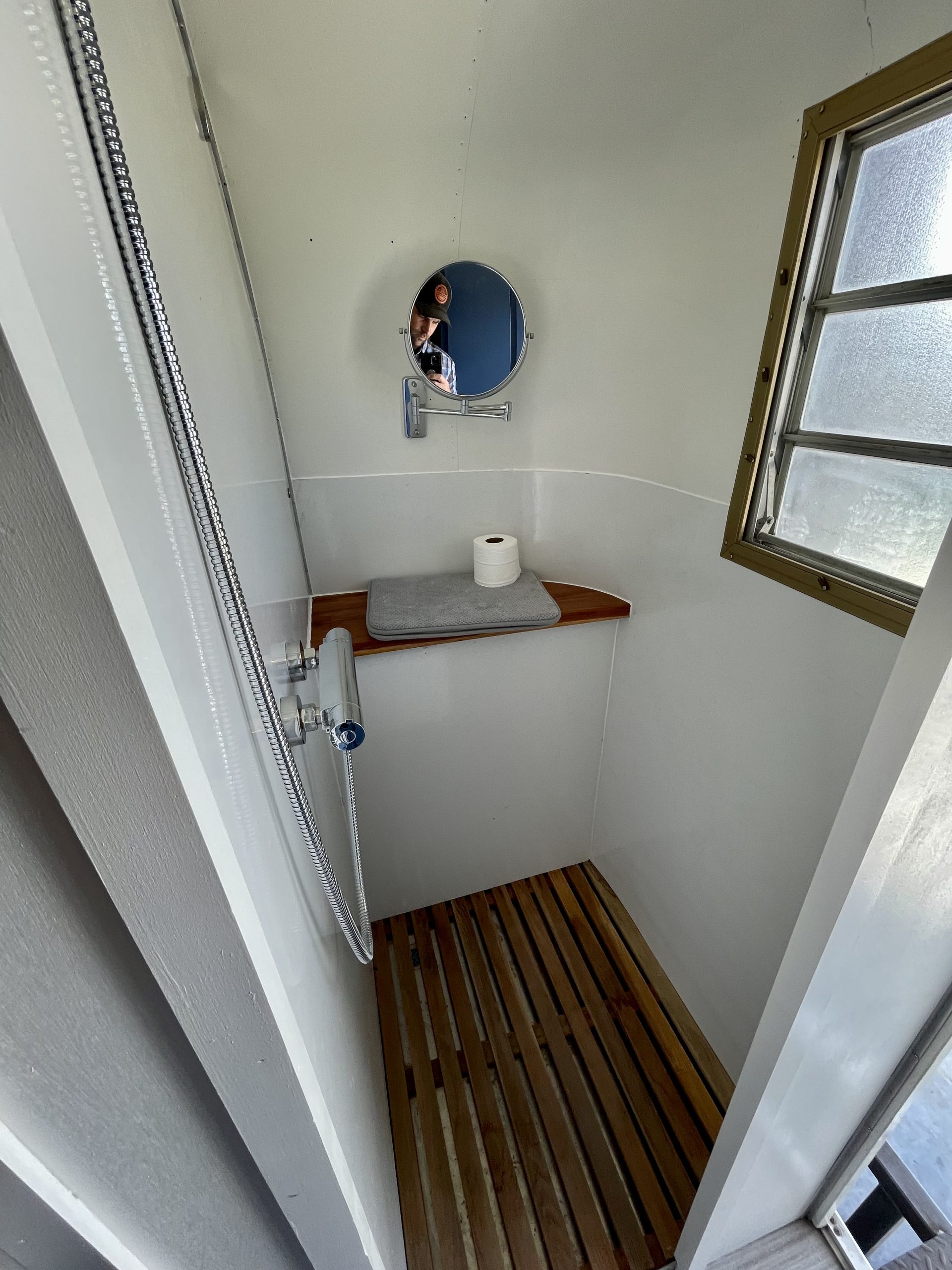
Brian also fabricated a custom stainless steel shower pan that drains into a new 22-gallon gray water tank.
One particularly clever touch is the removable cedar floor insert.
Anyone who has showered in a truck camper knows that perfectly level campsites aren’t always available. The cedar insert provides a raised standing surface, keeping feet out of any water that collects in the pan when the camper is parked slightly off-level.
Fresh water is supplied by a new 21-gallon tank.
For hot water, Brian initially installed an on-demand water heater, but the unit had an unfortunate limitation: it wouldn’t reliably produce hot water at elevations above 4,000 feet.
That’s a serious problem for someone who enjoys camping in the Rocky Mountains.
He eventually replaced it with a Fogatti on-demand water heater.
“We’ve since swapped it for a Fogatti on-demand heater, and it’s been excellent at altitude,” Brian said.
Between the new shower, portable toilet, updated plumbing, and on-demand hot water, the Avion’s bathroom is now far more functional than it was when the camper rolled off the assembly line more than half a century ago.
Modern Lithium Power Without Solar Panels
If there’s one area where Brian’s Avion has completely departed from its 1960s roots, it’s the electrical system.
The original equipment has been replaced with a modern lithium-based setup built around a single 200Ah LiFePO4 battery.
Battery monitoring is handled by a Victron SmartShunt, allowing Brian to check battery status and power consumption directly from his smartphone.
A Victron Lynx Power In provides a central connection point for the charging sources and electrical distribution.
But perhaps the most interesting aspect of the system is what it doesn’t have.
Solar panels.
That’s right. No solar.
While many modern truck camper owners are covering their roofs with increasingly large solar arrays, Brian decided they simply weren’t necessary for his style of travel.
“We really don’t use much power—just the fridge, fans, lights, and phone charging,” he explained. “Without any charging, the battery would last about four days.”
Instead, Brian relies primarily on a Renogy 40-amp DC-DC charger connected to the truck’s electrical system.
The charger is wired directly to the truck’s distribution block and uses the fog-light circuit as its activation trigger. When Brian switches on the fog lights while driving, the DC-DC charger is enabled to replenish the camper battery.
It’s an unusual arrangement, but one that gives him manual control over when the charger operates.
Brian reports that his setup can bring the battery from 50 percent to full charge in less than 30 minutes of driving. Actual charging time depends on the battery’s capacity, state of charge, charging current, and other conditions; a 40-amp charger alone would generally require considerably longer to replace half the capacity of a 200Ah battery.
For shore power, Brian installed a PowerMax 55-amp converter. The camper also received new LED lighting throughout, complete with dimmer switches.
And if Brian ever decides to add solar, the system is already configured to accommodate another charging source.
For now, though, he sees no reason to complicate a system that’s already meeting his needs.
“Since we’re usually moving every day, the DC-DC charger more than covers our needs.”
It’s a refreshing reminder that a well-designed electrical system doesn’t necessarily need every accessory available. Sometimes the best solution is the one that matches how you actually camp.



Meet Colonel Mustard: A 1975 Chevy with Cummins Power
As impressive as the Avion restoration is, we can’t talk about Brian’s camper without discussing the trucks that carry it.
And the first one is a real head-turner.
Meet Colonel Mustard, Brian’s 1975 Chevrolet C30.
While the truck retains its classic Chevy appearance, what’s under the hood is anything but original.
Brian swapped in a Cummins diesel engine from a 1996 Dodge and paired it with a six-speed manual transmission sourced from a 2006 model.
The combination brings diesel torque and modernized drivability to a classic heavy-duty pickup.
“I originally bought the Avion with this truck in mind,” Brian said.
Today, Colonel Mustard continues to handle local camping trips, pairing the vintage Avion with a truck from roughly the same era.
It’s a combination that looks right at home together.
For longer adventures, however, Brian and his family prefer something a little newer.
Their second truck is a 2022 Chevrolet Silverado 2500 equipped with GM’s 6.6-liter gasoline V8.
The Silverado was purchased new and has proven to be an excellent traveling companion, particularly when climbing mountain grades.
“We bought it new, and it’s been fantastic—especially on mountain passes,” Brian said.
To improve stability while carrying the camper, Brian installed AirLift helper airbags.
The modification has worked well for him, although as with any truck camper combination, actual loaded axle weights, tire capacities, and the truck’s GVWR remain important considerations.
With two very different trucks available, Brian gets the best of both worlds: classic-truck character for shorter outings and modern comfort and performance for cross-country travel.

The One Tool Every Avion Restorer Needs?
One of the biggest challenges Brian faced had nothing to do with plumbing, wiring, or riveting.
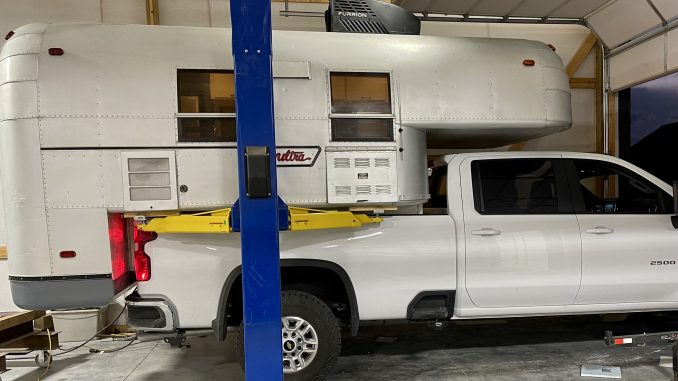
It was figuring out how to safely load and unload the camper.
Vintage Avions originally used three mounted camper jacks, but Brian wasn’t comfortable relying on the old arrangement and equipment.
“I didn’t want to use the original corner jacks—they just didn’t feel safe,” he explained.
His solution was decidedly unconventional.
He bought a two-post automotive lift.
Yes, the kind normally used in a professional automotive repair shop.
With an appropriate lifting arrangement, the equipment makes loading and unloading the Avion much easier and gives Brian greater confidence during the process.
It’s certainly not a solution every truck camper owner can adopt, but for someone who already enjoys working on and restoring vehicles, it fits right in.
Beyond that, Brian says the greatest challenge was simply having the patience to see the restoration through.
There were no magic shortcuts.
Just a lot of careful work, one repair at a time.
From the Garage to America’s Greatest National Parks
Of course, a beautifully restored camper doesn’t mean much if it never leaves the driveway.
Fortunately, Brian and his family have been putting their Avion to good use.
Their travels have taken them through some of the most spectacular landscapes in the American West, including Yellowstone, Grand Teton, Arches, Canyonlands, Mesa Verde, Great Sand Dunes, and Black Canyon of the Gunnison National Parks.
They’ve also explored Green River Lakes in Wyoming’s Wind River Range, driven Colorado’s famous Million Dollar Highway through the San Juan Mountains, and spent plenty of time camping in National Forests.
That’s an impressive travel résumé for a camper built more than 50 years ago.
And it demonstrates one of the enduring appeals of truck camping: the ability to explore places that would be more difficult to reach with a larger recreational vehicle.
As for future adventures, Glacier National Park is high on Brian’s wish list.
He has some reservations, however, after reading about restrictions that can make certain park roads challenging for larger truck camper combinations.
Those concerns are understandable. Glacier’s famous Going-to-the-Sun Road has vehicle size restrictions, making it important for truck camper owners to check their rig’s dimensions and current park rules before planning a trip.
Still, with so much of the American West already under their belts, it’s hard to imagine Brian and his Avion running out of places to explore anytime soon.


Final Thoughts: Don’t Get It Right, Just Get It Running
There is something particularly satisfying about seeing an old truck camper brought back to life.
In Brian’s case, the finished Avion C11 represents far more than a cosmetic restoration.
The camper has a rebuilt structure, new floor and wings, restored aluminum skin, updated cabinetry, a modern bathroom, new holding tanks, an efficient 12-volt refrigerator, and a lithium electrical system that supports the family’s camping habits.
And despite all those changes, it still looks unmistakably like an Avion.
That’s the beauty of a well-executed restomod. The original character remains, but the equipment and systems are brought into the modern age.
Perhaps the most impressive part of Brian’s project is that he didn’t wait until every detail was perfect before using the camper. He repaired the initial damage, enjoyed it for a couple of seasons, and then tackled the larger restoration when the time was right.
That philosophy is something he hopes other truck camper owners will embrace.
Brian points to a favorite saying from automotive personality David Freiburger:
“Don’t get it right, just get it running.”
It’s good advice for anyone restoring an old camper—or building a new adventure rig.
There will always be another modification to make, another accessory to install, or another little problem demanding attention. If you wait until everything is perfect, you might never leave home.
Brian’s vintage Avion proves that the real reward isn’t simply finishing the project.
It’s taking that project somewhere unforgettable.
And whether the camper is riding on Colonel Mustard or the modern Silverado, we suspect there are plenty more adventures ahead.
To follow Brian’s projects and adventures, find him on Facebook under Brian Uerling, on Instagram at @brian_uerling, and on YouTube at Carcaine Addiction.




Be the first to comment