





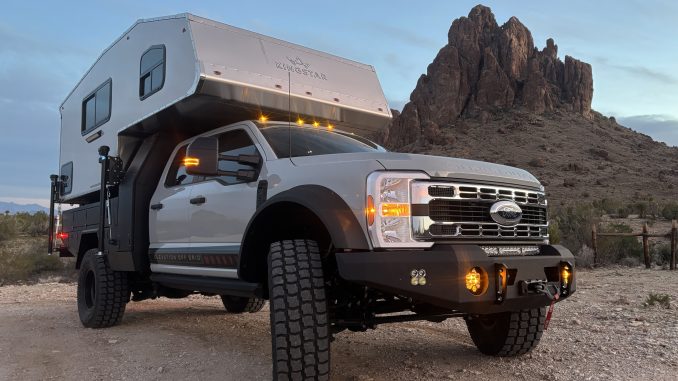
For builders creating the ultimate truck camper or expedition vehicle, few modifications generate as much discussion as the move to 41-inch super single tires. Once reserved primarily for military and commercial trucks, these oversized tires have become the standard on many premium overland builds based on the Ford F-350, F-450, F-550, and Ram 4500/5500 chassis.
Their appeal is easy to understand. Super singles offer exceptional load capacity, improved ground clearance, better flotation in sand and snow, and a simplified wheel setup compared to traditional dual rear wheels. They’re also better off-road. But choosing the right tire isn’t as simple as selecting the biggest tread available. With only four major options on the market, each tire has its own strengths, compromises, and loyal supporters.
During 2026 Overland Expo Pacific Northwest, Truck Camper Adventure spoke with two of the industry’s leading builders—Jerime Monroe of Elevation Off Grid and Dorian Hartfield of Buckstop Truckware—to learn why each company has chosen different tire platforms for their premium expedition trucks.
What Is a Super Single?
A super single replaces a traditional dual-wheel with one oversized commercial-grade tire. In the overlanding world, the most common size is the 335/80R20, measuring approximately 41 inches tall.
These tires typically carry load ratings between 6,300 and more than 7,400 pounds per tire, making them ideal for large truck camper rigs and expedition vehicles weighing over 16,000 pounds.
Better yet, their larger footprint improves flotation over soft terrain while providing increased ground clearance for rocky trails, snow, mud, and remote backcountry travel.
Need more proof that super singles outperform dual rear wheels? Just look at the vehicles built to handle the toughest conditions on Earth. High-end expedition rigs like EarthRoamers and heavy-duty military vehicles rely on super singles—not dual rear wheels. In fact, you won’t find a single vehicle in this weight class equipped with duals.
Installing 41-inch super singles is far more involved than a straightforward tire replacement. Proper integration typically requires suspension reengineering, a body lift to provide adequate ground clearance, axle upgrades with revised differential gearing to maintain drivability, heavy-duty 20- to 22-inch wheels engineered for increased load capacity, strategic body and fender modifications, and larger brake components to compensate for the added rotational mass and tire diameter. Both Buckstop Truckware and Elevation Off Grid offer engineered super single conversion systems designed to address these requirements.

The Four Major Players
Although dozens of commercial truck tires exist, only four brands dominate the 41-inch super single expedition market:
- Continental MPT 81 – Approximate Price: $900-$1,000: The Continental MPT 81 has become the benchmark expedition tire for many builders. It offers excellent off-road traction, balanced highway manners, and outstanding performance when aired down on sand or rough terrain. Many builders appreciate how easy the tire is to mount and balance, making installation straightforward compared to some competitors. Its primary limitation is a lower highway speed rating—typically 68 mph. The tire weighs 114 pounds and offers a maximum tire pressure of 94 PSI.

- Goodyear G275 MSA – Approximate Price: $2,000-$2,400: Used by Elevation Off Grid, the Goodyear G275 MSA occupies the premium end of the market. Originally developed for military applications, it features Kevlar-reinforced construction, a 6,395 pound load rating, exceptional puncture resistance, and one of the highest highway speed ratings available in this size—81 mph. While significantly more expensive than competing options, proponents argue the tire delivers outstanding ride quality and longevity when properly maintained. The tire weighs 120 pounds and has maximum tire pressure of 80 PSI.

- Petlas RM 910 – Approximate Price: $1,100-$1,200: Manufactured in Turkey and used by Buckstop Truckware, the Petlas RM 910 has rapidly become a favorite among several commercial expedition builders. It offers an 81-mph speed rating, a load capacity of 6,614 pounds, and long tread life, making it an attractive middle ground between performance and value. The tire weighs 125 pounds and offers a maximum tire pressure of 87 PSI.

- Michelin X Force ZL – Approximate price: $1,100 – $1,300. Originally designed for military service, it offers exceptional durability, aggressive off-road traction, and a survey best 7,385 pound load rating. Historically, however, availability has been limited because of military contracts, making the tire difficult for civilian builders to source. The tire weighs 135 pounds, offers a speed rating of 68 mph, and offers a maximum tire pressure of 95 PSI. EarthRoamer used to employ the Continental MPT 81 41-inch tire but changed to a 43-inch version of the Michelin X Force ZL tire in 2023 as stated in a recent interview with Truck Camper Adventure.

Why Elevation Off Grid Chose Goodyear
Jerime Monroe of Elevation Off Grid believes the Goodyear G275 MSA delivers the best overall driving experience despite its higher cost.
“The biggest benefit of the Goodyear is the higher speed rating,” Monroe explained. “You have an 81 mph speed rating that you don’t have with the Continental or Michelin.”
Monroe also believes the Goodyear is the quietest tire available in the super single market.
“It absolutely is the quietest tire in the space—no contest.”
Ride quality, however, isn’t the only reason Elevation Off Grid favors the tire. According to Monroe, tread life has proven exceptional when proper inflation pressures are maintained.
“We just replaced the rear tires on our shop truck after about 44,000 to 45,000 miles,” he said. “Those tires had never been rotated.”
That longevity, he says, helps offset the tire’s higher purchase price.
“I think you get better on-road performance. I think you get better wear characteristics. The potential to get double the lifespan of a Continental is absolutely there.”

Tire Pressure Matters More Than Brand
One of Monroe’s strongest messages wasn’t about tire brand—it was about tire pressure.
“Tire pressure is based on load,” he emphasized.
Running maximum pressure in an unloaded truck can negatively affect ride quality while accelerating uneven tread wear.
This, of course, is true for all tires not just supers.
For many unloaded Elevation Off Grid trucks, Monroe recommends approximately 55-65 psi in the rear and 60-70 psi in the front, depending on vehicle configuration. He stresses that every truck should follow a proper load chart rather than a one-size-fits-all pressure recommendation.
He also cautions that his recommendations are based specifically on Elevation Off Grid’s complete vehicle packages.
Wheel design, suspension geometry, vehicle weight, and overall build quality all influence tire wear.
Buckstop Truckware’s Case for Petlas
While Elevation Off Grid has standardized on Goodyear, Buckstop Truckware has taken a different approach. According to Dorian Hartfield, Petlas currently offers the best overall balance of performance, availability, and cost.
“We’re importing hundreds and hundreds a month,” Hartfield explained. “It’s our go-to tire.”
The Petlas carries an 81-mph speed rating while supporting roughly 6,700 pounds per tire.
According to Hartfield, tread life has been impressive.
“I have a customer with 30,000 miles, and he thinks he’ll get around 45,000 miles out of the set,” Hartfield said.
Noise levels also remain reasonable.
“It’s moderate on the noise level, and the tread life is super long.”
Perhaps its biggest advantage is value.
At roughly half the cost of the Goodyear, Hartfield believes the Petlas checks nearly every box buyers are looking for.

Thoughts on the Competition
Both builders acknowledged that every tire has strengths and weaknesses.
Hartfield noted that Michelin tires have historically been difficult to obtain due to military demand, although civilian availability appears to be improving.
He also pointed out that older Michelin tread designs could become noticeably louder as they wore.
Regarding Goodyear, Hartfield recalled quality-control issues from previous production runs involving balancing and occasional failures, but acknowledged he has not recently installed enough Goodyears to evaluate whether those concerns have been resolved.
Monroe, meanwhile, praised the Continental MPT 81 for being one of the easiest commercial tires to mount and balance, but questioned whether its tread life could match the Goodyear under similar conditions.
The Wheel Is Just as Important
One area where both builders agree is that wheels matter just as much as tires.
Hartfield strongly recommends one-piece wheels over split-wheel designs.
A conventional one-piece commercial wheel allows most heavy-duty truck tire shops to perform repairs and replacements without specialized parts or lengthy delays.
Split-wheel designs often require proprietary seals, hardware, or additional labor, making roadside service considerably more difficult.
For travelers heading deep into remote areas, simplicity often translates directly into reliability.

Repairing Super Singles
Unlike standard pickup tires, 41-inch commercial super singles generally require commercial truck tire equipment for mounting and repair.
Fortunately, commercial truck tire centers are common throughout North America, and punctures within the repairable tread area can often be professionally repaired using standard heavy-duty commercial tire repair procedures.
Owners should plan accordingly when traveling, recognizing that not every neighborhood tire shop has equipment capable of servicing these oversized commercial tires.
Which Super Single Is Best?
There is no universal winner.
The Continental MPT 81 remains one of the best all-around expedition tires, particularly for buyers prioritizing off-road capability and value.
The Goodyear G275 MSA excels in highway refinement, low road noise, and potentially outstanding tread life, although it commands the highest purchase price.
The Petlas RM 910 has emerged as perhaps the strongest value in today’s market, combining an 81-mph speed rating, high load capacity, impressive longevity, and broad availability.
Meanwhile, the Michelin X Force ZL continues to represent the premium heavy-duty option for builders requiring maximum durability and off-road performance.
Ultimately, the right choice depends on how the truck will be used. Long-distance highway travelers may appreciate the Goodyear’s refinement. Budget-conscious builders may find the Petlas difficult to beat. Hardcore expedition travelers may continue to favor the Continental or Michelin for their proven off-road credentials.
One thing is certain: regardless of which tire sits under the truck, proper tire pressure, quality wheels, professional installation, and regular maintenance will have just as much influence on performance and longevity as the name molded into the sidewall.
To learn more about Buckstop Truckware and Trail Ready products or to get a quote, email Dorian Hartfield at Buckstop directly at dorian@buckstop.biz.
To learn more about Elevation Off Grid trucks and products or to get a quote, email the company directly at sales@elevationoffgrid.com.





Super singles have been focused on military tires on 20″ wheels. I think this single-minded focus on what is available for the 20″ wheel is short-sighted. Buyers should be asking what is available in a desirable tire diameter, then on what wheels it takes to fit the truck. There are a LARGE number of commercial tires 42-43″ diameter (specifically 385/65R22.5, a 14-15″ wide tire and 12R22.5s, a 12-13″ wide tire) that are marketed to the ‘semi truck’ market for steer axle tires. These tires are priced from $275 for ‘cheap’ brands and start at $450 for name brands (Sumitomo and Falken specifically). Of course, some eventually reach the prices military tires start at…These tires have one significant attribute military tires don’t, they have double to triple the tire life. DBL Designs has released a 22.5 x 9″ wheel (good for 12R22.5) and is expecting a 22.5 x 11.75″ wheel (good for 385/65R22.5) by the end of 2026. I may be one of their first customers.