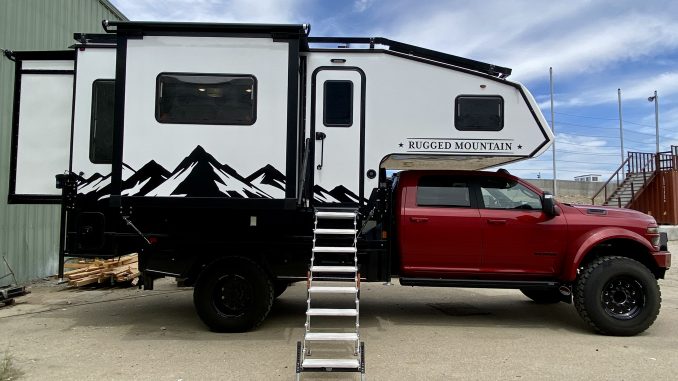
For truck camper owners who want maximum interior space and residential comfort, nothing beats a slide-out truck camper. By moving the dinette, sofa, galley, or even an entire rear wall outward after arriving at camp, a slide-out can dramatically increase usable floor space without making the camper excessively wide on the highway. Today’s market includes everything from relatively compact single-slide short-bed campers to enormous double- and triple-slide models with dry baths, theater seating, large kitchens, and expansive living areas. That additional space, however, comes with additional weight. Slide mechanisms, structural reinforcement, larger holding tanks, and the amenities typically found in these campers make slide-out models some of the heaviest truck campers built, making proper truck-and-camper matching especially important.
Payload is the first number you should look at when shopping for a slide-out camper. Don’t make the mistake of matching a camper’s advertised dry weight to the truck’s advertised maximum payload. The number that matters is the payload rating of the specific truck you’re buying, found on its Tire and Loading Information label, and the camper needs to be considered at its realistic loaded or wet weight. Water, propane, batteries, factory options, food, clothing, passengers, tools, and adventure gear all consume payload. The relationship with GVWR (Gross Vehicle Weight Rating) is equally important: the fully loaded truck and camper shouldn’t exceed the truck manufacturer’s GVWR, and the front and rear axle loads need to remain within their respective GAWRs. Ram’s truck-camper loading guidance specifically instructs owners to verify loaded axle weights on a scale and keep both axle loads and total vehicle weight within their ratings. Suspension upgrades such as airbags, heavier shocks, and sway bars can improve handling, but they do not increase the truck’s factory GVWR or GAWR.
Center of gravity (COG) is just as important as weight, particularly with large slide-out campers. Truck manufacturers specify a longitudinal center-of-gravity zone for carrying a slide-in camper, and federal regulations require applicable truck manufacturers to provide these limits specifically to help prevent improper truck-camper matching and the resulting adverse effects on steering and braking. Ideally, the camper’s loaded center of gravity should fall within the truck manufacturer’s specified zone, typically over or forward of the rear axle rather than behind it. This is especially important with long, heavy slide-out campers because loading too much weight behind the rear axle can remove weight from the front axle and negatively affect steering and handling. Loading matters, too: water, batteries, generators, gear, and other cargo can shift a camper’s actual center of gravity. Northwood recommends keeping heavy items low and sufficiently forward, distributing weight evenly from side to side, and weighing the front and rear axles separately after the camper is loaded.
For these reasons, the truck recommendations in our slide-out buyer’s guide become increasingly conservative as camper weight and the number of slides increase. Some lighter single-slide models can work well on a properly equipped one-ton SRW truck, while heavier single- and double-slide campers often make a one-ton DRW the better choice because of its additional payload, rear-axle capacity, tire capacity, and wider stance. Once you move into the heaviest triple-slide campers with loaded weights approaching or exceeding 6,000 pounds, a Class 5 truck such as a Ford F-550 or Ram 5500 can become the appropriate platform. Ultimately, don’t choose a truck simply because the camper physically fits in the bed. Match the camper’s realistic loaded weight and center of gravity to the payload, GVWR, GAWR, tires, wheels, and COG limits of the actual truck. Get those numbers right, and a slide-out camper can provide an extraordinary amount of living space and comfort without compromising the fundamentals of a properly matched truck camper rig.

| Model | Dry Wt | Wet Wt | Floor Length | Water Tanks | Propane | Slide-outs | Construction / Framing |
|---|---|---|---|---|---|---|---|
| Lance 855S Short-Bed | 2,857 lbs | ~3,191 lbs | 107″ | 30-20-25 | 40 lbs | 1 | Aluminum frame; Azdel composite and block-foam insulation; laminated fiberglass exterior |
| Arctic Fox 811 Short-Bed | 2,873 lbs | ~3,500 lbs* | 108″ | 50-38-23 | 60 lbs | 1 | Fully welded aluminum frame; laminated fiberglass exterior; block-foam insulation |
| Arctic Fox 990 | 3,010 lbs | ~3,750 lbs* | 118″ | 59-39-43 | 60 lbs | 1 | Fully welded aluminum frame; laminated fiberglass exterior; block-foam insulation |
| Arctic Fox 992 | 3,235 lbs | ~3,900 lbs* | 122″ | 46-39-37 | 60 lbs | 2 | Fully welded aluminum frame; laminated fiberglass exterior; block-foam insulation |
| HOST Tahoe 9.6 SB | 3,340 lbs | ~4,000 lbs* | 115″ | 65-43-32 | 50 lbs | 2 | Aluminum frame; vacuum-bonded fiberglass walls; block-foam insulation |
| Arctic Fox 1150 | 3,358 lbs | ~4,100 lbs* | 136″ | 59-35-43 | 60 lbs | 1 | Fully welded aluminum frame; laminated fiberglass exterior; block-foam insulation |
| Lance 975 | 3,394 lbs | ~3,857 lbs | 124″ | 45-30-26 | 40 lbs | 1 | Aluminum frame; Azdel composite and block-foam insulation; laminated fiberglass exterior |
| Lance 1062 | 3,424 lbs | ~3,884 lbs | 131″ | 45-27-22 | 40 lbs | 2 | Aluminum frame; Azdel composite and block-foam insulation; laminated fiberglass exterior |
| Arctic Fox 1140 | 3,465 lbs | ~4,200 lbs* | 136″ | 59-35-43 | 60 lbs | 2 | Fully welded aluminum frame; laminated fiberglass exterior; block-foam insulation |
| HOST Cascade 10.5 | 3,498 lbs | ~4,200 lbs* | ~126″ | 65-43-32 | 50 lbs | 2 | Aluminum frame; vacuum-bonded fiberglass walls; block-foam insulation |
| HOST Everest 11.6 | 3,890 lbs | ~4,850 lbs* | 136″ | 65-51-32 | 60 lbs | 3 | Aluminum frame; vacuum-bonded fiberglass walls; block-foam insulation |
| Rugged Mountain Granite Platinum | 3,898 lbs | ~4,698 lbs | 132″ | 30-38-24 | 40 lbs | 0 or 1 | Full composite construction; composite walls, roof and floor; four-season insulation |
| HOST Mammoth 11.6 | 3,955 lbs | ~4,700 lbs* | 136″ | 65-51-32 | 60 lbs | 3 | Aluminum frame; vacuum-bonded fiberglass walls; block-foam insulation |
| HOST Yukon 11.6 | 3,955 lbs | ~4,700 lbs* | 136″ | 65-51-32 | 60 lbs | 3 | Aluminum frame; vacuum-bonded fiberglass walls; block-foam insulation |
| Lance 1172 | 4,063 lbs | ~4,517 lbs | 143″ | 42-35-35 | 60 lbs | 2 | Aluminum frame; Azdel composite and block-foam insulation; laminated fiberglass exterior |
| Rugged Mountain Denali 1S Flatbed | 4,720 lbs | ~6,170 lbs | 141″ | 80-78-36 | 40 lbs | 1 | Aluminum frame; laminated fiberglass/composite construction; four-season insulation |
| Eagle Cap 1165 | 4,917 lbs | ~6,200 lbs* | 143″ | 66-41-41 | 60 lbs | 3 | Aluminum frame; laminated fiberglass/Azdel construction; block-foam insulation |
| Rugged Mountain Denali 3S Flatbed | 5,538 lbs | ~6,240 lbs | 149″ | 80-78-36 | 40 lbs | 3 | Aluminum frame; laminated fiberglass/composite construction; four-season insulation |
| Rugged Mountain Denali 3S XL Flatbed | 5,603 lbs | ~6,300 lbs* | 162″ | 80-78-35 | 40 lbs | 3 | Aluminum frame; laminated fiberglass/composite construction; four-season insulation |
Water Tanks: Fresh-Gray-Black in gallons.