





For years, Rugged Mountain RV has built a reputation by thinking big. Really big.
The Idaho-based manufacturer has become synonymous with luxurious composite flatbed campers featuring expansive interiors, residential finishes, massive battery banks, and enough storage to disappear off-grid for weeks at a time. Walk into one of the company’s flagship Denali models and it’s easy to forget you’re standing inside a truck camper. Instead, it feels more like a modern tiny home perched on the back of a pickup.
That’s exactly what has made Rugged Mountain such a unique player in the truck camper industry.
Ironically, it’s also what has limited its audience.
The reality is that most truck camper owners don’t drive Class 5 flatbed trucks. Most own 3/4-ton or one-ton pickups with standard pickup beds. They still want premium construction, true four-season capability, and enough electrical power to spend days—or weeks—off the grid, but they don’t necessarily need or want a 12-foot-long luxury hotel-on-wheels to do it.
Recognizing that gap in the market, Rugged Mountain RV founder Jesse Collinsworth decided it was time to build something entirely different.
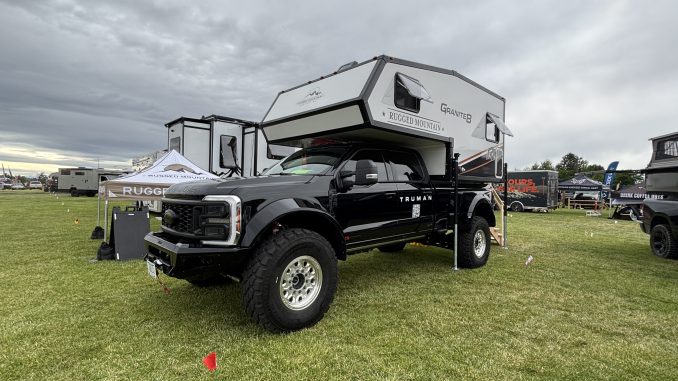
The result is the Granite 8, a compact hard-side composite truck camper designed to fit inside a conventional pickup bed with the tailgate closed. I first got my hands on the camper during its public debut at the 2026 Overland Expo PNW, where it immediately drew a steady crowd of curious campers. A few weeks later, I visited Jesse at Rugged Mountain headquarters in Emmett, Idaho, to learn more about the design, future plans, and why this camper may become one of the company’s most important products to date.
After spending time with the Granite 8, one thing became abundantly clear. This isn’t simply a smaller Rugged Mountain.
It’s Rugged Mountain entering an entirely new market.
Listening to Customers
One of the things I’ve always appreciated about Jesse is that he designs campers from the perspective of someone who actually uses them. Every design decision starts with a problem he wants to solve.
In this case, that problem was surprisingly simple. Customers wanted a camper that fit inside a standard pickup bed.
“We needed something that fits in a truck,” Jesse told me. “People don’t want to remove their tailgate. They don’t want to disconnect their backup cameras. They just want to load the camper and go.”
It sounds obvious, but that single requirement dictated almost everything about the Granite 8.
The camper has an 7-feet, 7-inch floor length so the tailgate can remain closed on long-bed pickups. Short-bed owners aren’t left out either. On a short-bed, the camper extends only to the end of the open tailgate, giving owners tremendous flexibility depending on the truck they already own.
That alone opens the Granite 8 to a much larger audience than Rugged Mountain has ever targeted before.

The Magic Number: 2,000 Pounds
Perhaps the most important number surrounding the Granite 8 isn’t its length or price—it’s its weight.
When the camper made its public debut at the Overland Expo PNW, it was perched atop a stunning Truman Motors Ford F-450 equipped with a LiquidSpring smart suspension and massive 44-inch tires. The truck certainly looked the part, but don’t let the heavy-duty display fool you. The Granite 8 wasn’t designed exclusively for F-450s or expedition builds.
In fact, the prototype tipped the scales at 2,166 pounds exactly as it sat on display.
For Jesse Collingsworth, however, that number is just the starting point.
He’s already identified several ways to trim another 150 pounds or more from production models by switching to lighter seven-layer birch plywood in select areas, eliminating prototype-only components, and refining the manufacturing process. His goal is to bring the Granite 8 in at roughly 2,000 pounds dry.
That target isn’t arbitrary.
Every year I receive countless emails from readers asking the same question:
“What’s the lightest composite truck camper I can realistically carry on my 3/4-ton pickup?”
Until now, the list of answers has been surprisingly short.
Many composite campers have evolved into premium expedition rigs loaded with luxurious amenities—and the weight that comes with them. They’re outstanding campers, but they’re often better suited to one-ton pickups, flatbeds, or even medium-duty trucks.
Rugged Mountain’s Granite 8 changes that conversation.
At around 2,000 pounds dry, a properly equipped Ford F-250, Ram 2500, Chevrolet Silverado 2500HD, GMC Sierra 2500HD, or similar 3/4-ton pickup suddenly becomes a realistic option for a premium composite camper. Move up to a one-ton truck, and payload concerns become even less significant, leaving plenty of capacity for options, passengers, gear, and supplies.
That’s a pretty big deal.
For years, buyers have had to choose between the benefits of lightweight conventional campers or the durability and four-season performance of composite construction. With the Granite 8, Rugged Mountain is attempting to give truck camper owners the best of both worlds—a true composite camper that doesn’t require a massive truck to enjoy.
Small Outside, Surprisingly Spacious Inside
One of my biggest surprises when walking into the Granite 8 was how open it felt.
Most 8-foot campers naturally feel a little confined. Manufacturers typically place the bathroom across the rear wall, creating a narrow hallway leading to the cabover bed.
Rugged Mountain took a completely different approach.
Instead of sacrificing the rear of the camper to the bathroom, Jesse preserved one of his favorite design elements—the panoramic rear seating area. When you sit at the dinette, large wraparound windows surround you with nearly 180 degrees of visibility. It’s one of those features that doesn’t fully register until you’re actually sitting there imagining your next campsite.
Picture yourself parked beside an alpine lake.
Or overlooking the Pacific Ocean.
Or tucked into a desert canyon at sunset.
Those windows suddenly become the focal point of the entire camper. You don’t feel boxed in. You feel connected to wherever you’ve parked.
That’s exactly how truck camping should feel.

The Bathroom That Shouldn’t Work…But Does
Of course, keeping those panoramic windows created another challenge. Where does the bathroom go?
Jesse’s solution may be one of the cleverest packaging ideas I’ve seen in years.
Instead of placing the wet-bath across the back wall, Rugged Mountain moved the entire bathroom onto the passenger-side wing. As far as Jesse knows, no other manufacturer has done this.
I’ll admit I was skeptical. On paper, putting the bathroom and toilet over the wing sounded like it would create an awkward, cramped space.
Then I stepped inside. It works. Really well.
Because you walk straight into the shower instead of squeezing around corners, the bathroom actually feels larger than its dimensions suggest. The retractable shower door keeps everything open, while a roof skylight restores standing room for taller users.
Yes, emptying the cassette requires lifting it slightly farther than a conventional rear-mounted design, but the tradeoff is well worth it in my opinion. You gain an entirely different living experience inside the camper.
For me, that’s a trade I’d happily make.
Residential Roots Still Shine Through
Longtime Rugged Mountain owners often describe their campers as feeling more like custom homes than RVs—and for good reason. Before building truck campers, the company’s expertise was rooted in tiny home construction, where residential comfort and attention to detail came first.
That philosophy carries directly into the Granite 8.
Cabinetry looks like furniture rather than RV cabinetry. The finishes are clean and modern. Counter space is generous for a camper this size.
Even in prototype form, the interior immediately felt familiar.
When I walked inside, there was never any question whose camper I was standing in. It looked unmistakably like a Rugged Mountain. That’s not easy to accomplish while downsizing nearly every dimension of a camper.
Yet somehow they pulled it off.


Composite Construction Isn’t Just a Buzzword
Composite construction has become one of the hottest topics in truck campers over the past decade. Unfortunately, not all composite campers are built the same.
The Granite 8 uses Globe Trekker 1.5-inch fiberglass/PIR foam/fiberglass composite panels with no structural aluminum or wood framing inside the walls.
Why does that matter? Because traditional framed walls create thermal bridges. Every aluminum stud becomes a pathway for heat to escape during winter—or enter during summer. Remove the framing, and those thermal bridges largely disappear. The result is more consistent insulation, fewer cold spots, and less condensation.
Combined with approximately R-12 insulation, dual-pane acrylic windows, and an insulated composite floor, the Granite 8 is engineered from the ground up for four-season camping.
That’s not marketing fluff. That’s engineering.

True Four-Season Capability
One of the first things I asked Jesse was where the tanks were located. His answer made me smile. They’re inside the heated basement.
Fresh water capacity comes in at 30 gallons, matched by a 30-gallon gray tank, while waste is handled by a 4.7-gallon Thetford cassette toilet.
The basement receives warm air directly from the exceptionally-efficient, ultra-quiet Truma Combi water heater-furnace, keeping tanks, plumbing, and dump valves protected during freezing weather.
Even the gray tank valve stays inside the insulated basement instead of hanging exposed beneath the camper.
That’s exactly how true four season truck campers should be engineered.
Rugged Mountain Doesn’t Believe in Small Electrical Systems
If you’ve followed Rugged Mountain for any length of time, you already know Jesse loves electrical systems. That philosophy hasn’t changed.
Even though the Granite 8 is aimed at a lighter market, buyers can still equip it with up to 800 watts of rooftop solar, a 3,000-watt Victron inverter, and either three SOK 314-amp hour lithium batteries or three Expion360 450 amp hour batteries.
That’s serious off-grid capability for a 3/4-ton truck.
It’s enough energy to comfortably power refrigeration, laptops, Starlink, induction cooking, camera equipment, and much more while camping far from hookups.
Most campers in this size category simply don’t offer that level of flexibility.
Built Around Options
One thing Jesse emphasized repeatedly during our conversation is that the Granite 8 is designed to fit different buyers. The prototype intentionally debuted as a lightweight base model.
Production units can add:
- Upper kitchen cabinets
- Larger 12-volt Furrion refrigerator
- Houghton roof air conditioner
- Fold-away bunk bed
- Expanded solar
- Larger lithium battery systems
- 3,000-watt inverter
- Queen or optional king bed
That means a 3/4-ton owner can keep weight to a minimum while a one-ton owner can comfortably load nearly every available option.
It’s a smart approach. Instead of forcing buyers into one configuration, Rugged Mountain lets owners build the camper around their truck.

Honest Weights Matter
One comment Jesse made during our interview really stood out. He intends to weigh fully optioned production campers. Actually weigh them. Not estimate them. Not calculate them.
Put them on a certified scale.
As someone who spends an unhealthy amount of time matching truck campers to payload ratings, I appreciate Jesse’s commitment to publishing actual scale weights.
Truck camper buyers deserve real numbers—not optimistic brochure weights that seem to assume you’ll be camping with no batteries, no awning, no air conditioner, no solar, no options, no water, and perhaps no hope. Too often, a camper gains several hundred pounds between the brochure photo shoot and the dealer’s lot, leaving owners to discover the difference the first time their rear suspension starts giving way to gravity.
Knowing exactly what you’re putting in your truck makes everyone safer.
Final Thoughts
The Granite 8 represents far more than another model in Rugged Mountain’s quality lineup.
It represents a shift.
For years, composite truck campers have largely occupied the premium end of the market, often requiring bigger trucks and bigger budgets. Rugged Mountain is attempting to change that by delivering many of the advantages of composite construction in a package that’s lighter, more affordable, and compatible with trucks that thousands of people already own.
After walking through the camper twice, talking with Jesse both at Overland Expo and later at the factory, and seeing the amount of thought that went into its design, I came away genuinely impressed.
The Granite 8 doesn’t feel like a stripped-down version of something bigger. It feels purpose-built. Every inch serves a purpose. Every design decision solves a problem. Every pound appears to have been scrutinized.
Will it be successful?
If the production models hit their weight targets while maintaining the quality Rugged Mountain is known for, I think the Granite 8 has the potential to become one of the most significant composite truck camper introductions we’ve seen in years.
More importantly, it could introduce an entirely new generation of truck owners to the Rugged Mountain brand.
Sometimes thinking smaller is exactly how you make the biggest impact.
To learn more about the new Rugged Mountain Granite 8 or to get a quote, email the company directly at ruggedmountaincustomrv@gmail.com.


Be the first to comment