




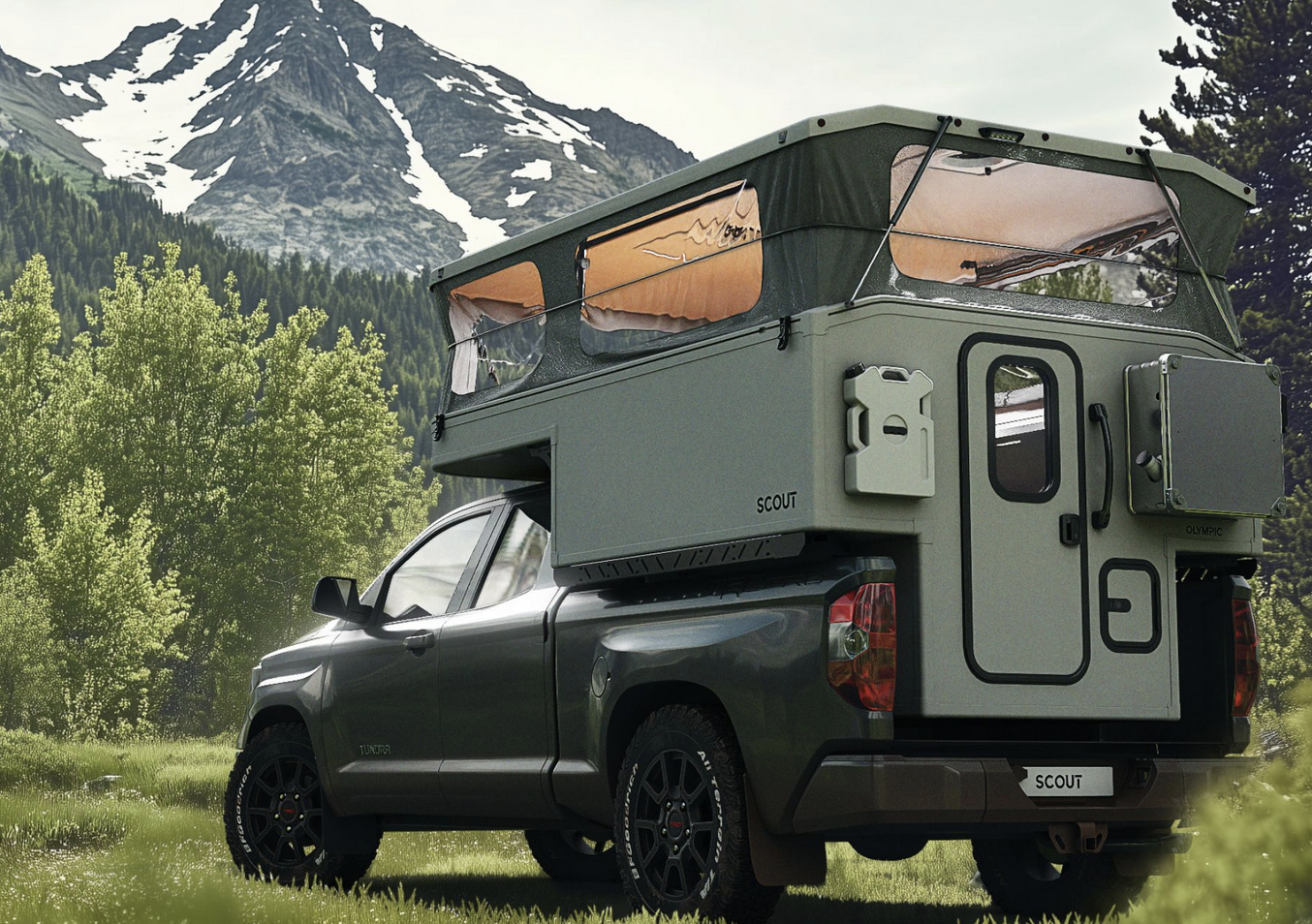
Our good friends at Adventurer Manufacturing just released the Scout Kenai Pop-Up, an innovative, lightweight camper for long-bed pickup trucks. The new release also marks a milestone for Scout’s catalog that now includes a triumvirate of sleek and modern pop-ups—the Yoho, Olympic, and Kenai.
It’s been five years since Adventurer Manufacturing released its first Scout camper, the Olympic, a hard-side truck camper for full-size trucks. With its low weight, basic floorplan, and portable appliances, the Scout Olympic was revolutionary for its time. Everything inside it from the propane cooktop, the refrigerator, the dining table, to the diesel furnace, the 4.9-gallon filtered water tank, and the lithium power station, was modular and portable, meaning most could be used inside and outside the camper.
With a comparatively low starting cost under $20,000, the response from consumers was overwhelming. The Olympic, along with the Yoho, Kenai, and Tuktut followups sold like hot cakes. The company had trouble keeping up with the demand.
Adventurer Manufacturing Owner and CEO, David Epp, was thrilled with the Scout’s response. He saw the need for lightweight, minimalistic hard-side campers that could be safely hauled on lower rated pickup trucks and he built them, lots of them. But Epp had an Ace up his sleeve that nobody knew about.

Fresh on the heels of Scout’s overwhelming success, we interviewed Epp about his ground-breaking campers. As the interview drew to a close, he asked who we thought built the best pop-up camper. At first, we were taken aback by the question. He had never built a pop-up camper before. Why was he asking about pop-ups? After providing him with a list of our favorites, he revealed that he was designing his first pop-up. It would be offered under the Scout banner. This was ground-breaking news. Scout was about to take on pop-up heavy weight Four Wheel Campers, but we were sworn to secrecy.
Epp, of course, stayed true to his word. As of today, his catalog includes three Scout pop-ups—the Yoho, Olympic, and the Kenai. Like the hard-side models, the Yoho is the lightest and smallest pop-up of the three, and weighs only 976 pounds. The larger and heavier Olympic and Kenai are made for full-size pickups like the Ford F-150, Ram 2500, and Chevy Silverado 3500HD, with the Olympic built for short-bed trucks and the Kenai for long-bed trucks. The campers weigh 1,145 pounds and 1,331 pounds respectively. According to Epp, there are no plans to release a Tuktut pop-up, but he hasn’t entirely ruled that out.
So why did Epp want to design and build a pop-up camper when he already had a wildly successful off-road product with the Scout hard-wall campers?

“It was an opportunity for us to bring further innovation and incorporate some of the design elements that we brought from the hard-wall space to the pop-up space,” Epp explained. “We saw it as a natural transition. When we looked at the pop-up market, we saw it not as a direct competition, but an indirect competition to our hard-wall campers, because if there was one product segment or product type that we would be up against, it was pop-ups.”
Epp has a point. Attend any overland expo or rally, and you’ll see hundreds of pop-up campers. Pop-ups are popular for a reason, especially, when you consider the pros and cons of the pop-up. The camper’s low profile results in less wind resistance and better fuel economy on highways. The pop-up’s lower profile and lower center of gravity is better off-road. It can tackle rough forest service roads with low hanging trees and pass under rugged rock outcroppings that would stop a hard-side camper dead in its tracks. In general, the pop-up is lighter too, and unlike its larger cousin, it can also be stored in most residential garages.

“A pop-up loyalist is a loyalist for a reason,” Epp explained. “They’re like, ‘I have to be compact for tight trails, or I have to be compact because I want to fit this in my garage at home.’ Those are ones that we couldn’t win, even though they loved who we were, they had a hard line on what they would want to do. So it’s like, ‘okay, let’s assess this. Let’s get to a position where we’re feeling really good about the models that we’re offering in our hard-wall campers, and this could be a natural transition.'”

When you already have three wildly successful camper templates to work with, the transition to building three pop-ups was as natural as it can get. According to Epp, everything from the bunk down is identical to the three hard-side models. The pop-ups use the same panels, the same extrusions, and the same geometries as the Yoho, Olympic, and Kenai hard-side models. Basically, Scout took all of the strengths of the hard-side and made sure that they were transferred to the pop-up version whenever possible. The roof, however, isn’t totally flat. The vacuum-infused composite roof of each camper has a slight dome to it to prevent water from pooling up, yet the roof is strong enough to support Kayaks and an air conditioner.
“We saw opportunities for innovation in that space,” Epp said. “How can we bring our materials, our construction, our esthetic, and then add immediate value to that market segment? So what we did is that we actually developed it with the domed roof. Most roofs are inherently flat. So we’re just like, ‘hey, how do we add value by bringing a cool feature like that that’s functional and it serves a purpose by shedding water, but also helps us achieve our Scout esthetic as a whole with the radius front and also the similar slopes that we have in our hard-wall designs?”
The key element of any pop-up truck camper design is the roof lift mechanism. Most companies employ a 12 volt lift, but some still rely on a manual lift or a hydraulic system to raise the roof. After month’s of design work, Scout decided to go with a hybrid manual-hydraulic system with dual stage, hydraulic struts that lock into place. A single person can activate it and no power is needed. Epp tells us that the design is patent-pending.

“The last challenge that we overcame was designing the pop-up mechanism,” Epp said. “Frankly, a lot of the systems out there are not easy to operate. It takes some, how would I say? It takes some strength, obviously, to open it up, and it’s a little strenuous. The only solution to that is going to a more complex system that requires power, like a linear actuator lift system, but then you have complexities in that. That’s not Scout, that’s not who we are, but we have to make it easy because that’s our ethos. What we did is we challenged our team. It’s like, ‘hey, here’s our opportunity to solve a challenge and offer immediate value into this market segment. Make it easy. It doesn’t matter who owns this. They can set it up with ease. Right. It doesn’t limit who you are, your stature as a human at all. You can get out and use our product and enjoy it.'”
A large benefit of the Scout pop-up design are the views. The six soft-wall windows provide panoramic views and a seamless connection to the outdoors. Made from coated 300D honeycomb rip-stop fabric, the windows are fully waterproof, UV-resistant, and mold-resistant, ensuring durability in any weather. Each window comes with a bug screen, a clear zip-up window, and a fabric layer for privacy.

While the Scout pop-ups are different in some ways, in many ways they are still the same. After stepping inside you’ll immediately recognize Scout’s trademark interior. The standard features and options are pretty much the same too. All come with a 4.9 gallon portable water tank, a 200 watt solar power system, and an Expion360 132 amp hour portable lithium battery power station, a 12 volt roof vent, LED lights, and USB charging stations.
The company offers a bevy of options too that include a propane cooktop, a 500 watt inverter, a Dometic CFX3 55L DC refrigerator-freezer with WiFi, a Kammok Crosswing Awning, a diesel heater, a portable Dometic 2.6 gallon toilet, and a “portaledge” 24-inch slide-out bunk extension.
The three Scout pop-ups are relatively affordable too with the Yoho listing for $27,900, the Olympic for $29,990, and the Kenai for $32,990.
So with the Scout Olympic and Scout Kenai pop-ups just released, what kind of feedback has the company received thus far?
“The feedback has been great, especially with the Yoho Pop-Up’s release last summer. As soon as that product went live, we were getting buried with DMs and comments almost immediately. ‘When’s the Olympic pop-up coming? When’s the Kenai pop-up coming?’ The pop-ups were a response to what people were asking from us. They wanted the same simplistic esthetic and design functionality of the Scout hard-wall, but they wanted it in the pop-up. So this has been a fun journey, and it’s made the response enjoyable from a marketing perspective. This is what people have been wanting from us, and we’re just delivering it to them now,” he said.
To learn more about Scout Campers or to get a quote, contact the company directly at sales@scoutcampers.com.





Be the first to comment