





For decades, truck camper buyers have faced a familiar dilemma.
Do you choose a lightweight pop-up that can follow your truck deep into the backcountry, or a hard-side camper that offers better insulation, more storage, and a residential feel? According to Kelsey Panich of Supertramp Campers, that choice may no longer be necessary.
Standing inside the company’s Colorado-built Flagship HT, Panich smiles when discussing the two campers that have become the centerpiece of Supertramp’s growing reputation: the Flagship LT and the Flagship HT. On paper, they appear dramatically different. One features an electric pop-top with panoramic fabric walls. The other is a fully rigid hard-side camper designed for maximum comfort in extreme conditions.
Yet the reality is far more surprising.
“The base weight of the Flagship LT is around 1,350 pounds,” Panich explained. “The Flagship HT is around 1,450 pounds. That’s only a 100-pound difference.”
For many truck camper enthusiasts, that’s the moment the conversation gets interesting.
The Camper That Floats Like a Feather
The Flagship LT was designed around a simple philosophy: build a rugged home that doesn’t weigh down the truck carrying it.
The result is a modern pop-up truck camper that combines lightweight construction with true four-season capability. Unlike many traditional soft-wall campers, the LT features a three-layer insulated fabric system designed to handle everything from summer heat to winter snow, making it a highly capable four season camper.

When deployed, the electric lifting system raises the roof at the touch of a button, revealing an impressive 6-foot-9-inch interior height and 360-degree views through large surrounding windows. It’s a camper built for adventurers who want to explore remote trails without restrictions.
“We designed this model for the modern explorer who refuses to be weighed down,” Panich said.
The Flagship LT’s fully composite shell is manufactured in-house using vacuum-infusion technology, helping keep weight between roughly 1,350 and 1,750 pounds depending on configuration. Despite its lightweight design, the camper still includes amenities many travelers now consider essential, including a Truma Combi heating and hot-water system, a 65L DC compressor refrigerator, lithium battery power, solar charging, air-conditioning capability, and a 24-gallon fresh-water tank.
In other words, lightweight no longer means stripped down.
The Hard-Top That Defies Expectations
Then there’s the Flagship HT, Supertramp’s hard-side camper. At first glance, buyers naturally assume the hard-side must weigh substantially more than its pop-up sibling. Not so. One reason is that the LT’s insulated fabric, electric actuators, wiring, and lifting hardware add more weight than many people realize.
“The fabric is heavier than you would anticipate,” Panich explained. “Then the electric linear actuators are not light, and all the wiring that we have to do with that.”
Meanwhile, Supertramp worked aggressively to keep unnecessary weight out of the HT. The company uses lightweight aluminum cabinetry, extensive window openings, and advanced composite construction techniques to minimize mass. Panich noted that the camper’s roof section is so light that a single person can lift it.

The secret lies in Supertramp’s proprietary fiberglass manufacturing process. Rather than relying on traditional fiberglass layup techniques that can saturate parts with excess resin, Supertramp uses vacuum infusion technology to precisely control resin content.
“You’re only putting the right amount in,” Panich said. “You’re not overloading that part.”
The result is a hard-side camper that delivers excellent insulation, increased storage, and a more residential feel without carrying the weight penalty buyers often expect.
Built for Four Seasons
Both Flagship models share one important characteristic: they’re designed to be used year-round.
The LT combines its insulated fabric walls with a 1.5-inch composite shell, while the HT relies entirely on its rigid composite structure for insulation. In either configuration, owners get a camper designed to handle everything from mountain snowstorms to desert heat. Both the LT and HT feature block foam with an R7 insulation rating. Better yet, Supertramp’s fiberglass construction all but eliminates thermal bridging making both campers excellent four season campers.
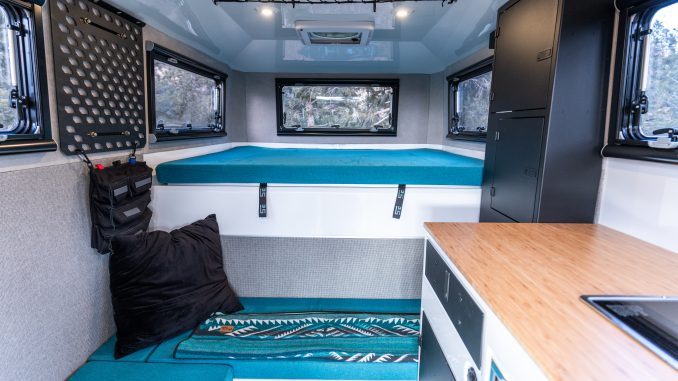
The HT particularly shines when conditions turn nasty. Its fully rigid shell feels remarkably solid in high winds, while six large dual-pane Arctic Tern windows provide exceptional visibility and ventilation when temperatures climb.
Panich describes the experience as feeling more like an apartment-on-wheels rather than a traditional truck camper.
Power for the Long Haul
Whether buyers choose Supertramp’s Flagship LT or Flagship HT, the off-grid systems are virtually identical.
Every Flagship comes standard with 330 watts of rooftop solar, Victron power-management components, and a 30-amp DC-to-DC charger. In 2025, Supertramp expanded its charging options considerably, allowing customers to upgrade to as much as 100 amps of DC-to-DC charging capacity.
Perhaps even more impressive is the available battery bank. Customers can now order up to 800 amp-hours of heated lithium batteries. That kind of capacity would have seemed almost absurd in a truck camper just a few years ago.

The breakthrough came when Supertramp transitioned to Victron lithium batteries, which occupy less space than the battery systems the company previously used. By strategically placing four 200 amp-hour batteries beneath seating areas and incorporating storage shelves above them, the company managed to preserve much of the interior storage space while dramatically increasing energy capacity.
“Our air conditioner users really like that,” Panich said with a laugh.
Why Supertramp Loves the Truma Combi
Heating systems may not be the most glamorous topic in the RV world, but Panich becomes noticeably enthusiastic when discussing the Truma Combi. The system serves as both a furnace and water heater, and according to Panich, it has proven exceptionally reliable in real-world use.
“We love how quiet it is,” she said. “It’s been pretty much a flawless product for our customers out on the road.”
Unlike many heaters that dump warm air from a single location, the Truma distributes heat throughout the camper via ducted vents, creating more consistent temperatures and eliminating cold spots. Although Supertramp now offers a diesel-powered Combi for customers seeking a single-fuel solution, propane remains the standard choice.
For many travelers, propane still makes perfect sense. It powers cooktops, fire pits, outdoor grills, and a variety of camping accessories. Diesel simply provides another option for those who prefer it.
A Different Approach to Interior Design
Inside both Flagship models, Supertramp has largely abandoned traditional RV construction techniques. Instead of wood cabinetry, the company uses composite cabinet structures paired with aluminum drawer fronts that are cut and finished in-house. The result is an interior that feels clean, modern, and surprisingly spacious.
Panich believes the bright white surfaces help open up the living area while also making cleanup easy after muddy adventures.

The company pairs those composites with an L-shaped seating arrangement that encourages relaxation. Rather than forcing campers into rigid dining positions, the layout allows occupants to stretch out, claim a corner, and settle in comfortably after a day outdoors.
“It’s really nice and easy on the eyes,” Panich said.
The Only Wood You’ll Find
For a company so committed to composites and aluminum, there’s one notable exception. Bamboo. The countertops and lagoon table feature bamboo surfaces accented by attractive edge banding.
For Panich, the decision wasn’t just aesthetic.
“We really wanted to make this feel comfortable and homey,” she explained. Without those natural materials, the interior risked feeling overly industrial. The bamboo introduces warmth and texture while remaining lightweight and durable. Interestingly, it’s virtually the only wood found throughout the camper.
Everything else relies on fiberglass, composites, and aluminum. Indeed, Supertramp builds campers the way sailboat builders build yachts—out of composites and other durable materials designed to laugh at time, weather, and thousands of miles of rough roads.

Hidden Engineering
Many visitors assume the camper’s benches and cabinets are molded directly into the shell. The reality is considerably more sophisticated. The shell, roof, cabinetry, seating, and interior components are all manufactured separately before being assembled during final production.
That approach allows technicians to install electrical systems, propane storage, plumbing, gray-water tanks, heating equipment, and other critical systems before the cabinetry is installed.
As Panich describes it, the camper’s “brains” live primarily inside the kitchen area, hidden behind sleek cabinetry and carefully organized systems.
It’s an approach that keeps serviceability high while maintaining the clean interior appearance owners appreciate.
More Storage Than You Think
Yet, compared to the lift-top model, the Flagship HT does have one ace up its sleeve—storage. It’s one of the Flagship HT’s biggest selling points. The fixed roof allows Supertramp to add tall pantry cabinets, corner storage compartments, and MOLLE panels for hanging jackets, backpacks, and outdoor gear. Customers who need additional capacity can even add more cabinetry to suit their travel style.


Another standout feature is the HT’s king-size flip-up bed. The bed converts into a north-south sleeping arrangement in roughly ten seconds, creating a spacious sleeping area without permanently consuming valuable living space.
According to Panich, customer response has been overwhelmingly positive.
“It’s been a huge hit,” she said.
The Truck Question
Eventually, every truck camper conversation arrives at the same question: What truck do I need? For Supertramp, the answer is straightforward. The campers were designed around a 6.5-foot bed, although installations on 5.5-foot and 8-foot beds are possible.
If Panich were purchasing a truck specifically for one of these campers, however, she’d move directly to a 3/4-ton platform. The most common pairing leaving Supertramp’s facility today is the Ford F-250, although the company works comfortably with all major truck brands. For buyers looking to maximize payload, stability, and future flexibility, the recommendation is clear: bigger is usually better.


The New Reality of Truck Campers
Perhaps the most remarkable aspect of Supertramp’s Flagship lineup isn’t the composite construction, the massive lithium battery bank, or the top notch quality. It’s the fact that buyers no longer have to make the compromises that once defined the truck camper market.
Want a lightweight pop-up camper with true four-season capability? The Supertramp Flagship LT delivers.
Want a hard-side camper with more storage and apartment-like comfort? The Supertramp Flagship HT offers that too.
And with only about 100 pounds separating the two designs, the decision becomes less about weight and more about how you like to travel.
For truck camper adventurers, that’s a pretty good problem to have.
To learn more about Supertramp campers or to get a quote, email the company directly at info@supertrampcampers.com.





Be the first to comment