




There’s something refreshing about a truck camper that doesn’t try to be everything to everybody.
At a time when new truck campers routinely arrive loaded with touchscreens, massive lithium battery banks, elaborate entertainment systems, and price tags that can rival a new pickup truck, Old School Campers is heading in the opposite direction.
The Goshen, Indiana, manufacturer is building simple, lightweight hard-side truck campers with traditional construction, classic styling, straightforward systems, and—perhaps most importantly—prices that ordinary people can still afford.
And that simplicity isn’t accidental. It’s the entire business model.
“Skip the dealer, buy from the builder,” Old School Campers founder Bob Taulbee told Truck Camper Adventure during a recent interview.
It’s a catchy slogan, but it also neatly summarizes what Taulbee is trying to accomplish. By selling factory-direct from Elkhart County, Indiana—the heart of America’s RV manufacturing industry—Old School eliminates the traditional dealer markup and keeps its campers deliberately simple enough to control production costs.
The result is a lineup of hard-side truck campers starting at just $13,900, with even the company’s largest model coming in at $17,900 in its standard “old school” aluminum configuration.
In today’s truck camper market, those numbers certainly get your attention.
But affordability is only part of the story.
An RV Industry Veteran Goes Old School
Despite the company’s relatively young age, Bob Taulbee is hardly a newcomer to the RV business.
His career stretches back decades and includes experience with truck campers, travel trailers, fifth wheels, sales, manufacturing, and product development. One of his early positions was with Scamper, where he worked as a sales representative, followed by stints with Alpha Leisure and SunLite.
But perhaps the most interesting chapter came at Riverside RV in LaGrange, Indiana.
When Taulbee arrived, Riverside was a tiny operation with two Amish craftsmen working out of a pole barn behind the owner’s farmhouse.
Then came the Retro.
Taulbee helped develop the retro-styled travel trailer line around 2010, taking inspiration from the small, rounded campers of decades past. The reaction was immediate.
“We’d have people lined up 15 deep just to look inside,” Taulbee recalled.
According to Taulbee, Riverside eventually grew from those two employees to more than 100, expanded into roughly 153,000 square feet of manufacturing space, and became a roughly $40 million company.
The experience taught him something important: retro sells.
More specifically, people have an emotional connection to RVs that look like the campers they remember from childhood, family vacations, and campgrounds of decades past.
Taulbee liked the concept so much that he kept another name tucked away for a future venture: Old School.
In 2018, he finally put it to use.
A Truck Camper That Actually Looks Old School
One glance at an Old School truck camper explains the name.
Rather than hiding its traditional construction beneath gaudy graphics and elaborate molded caps, the company embraces the classic truck camper aesthetic. White aluminum siding is the standard exterior treatment, typically accented with black trim, although a catchy red trim is also available.
Fiberglass siding can be substituted for an additional $1,000.
Interestingly, Taulbee says most customers still choose aluminum.
That makes sense.
There’s something undeniably charming about a traditional aluminum-sided truck camper sitting in the bed of a pickup. It looks like a truck camper because, well, that’s exactly what truck campers looked like for decades.
Old School isn’t trying to disguise that heritage.
It celebrates it.

Traditional Wood Construction—Done Right
Of course, mention wood-frame construction in today’s truck camper market and you’re bound to start a debate.
Old School makes no apologies for using it.
The campers are framed with sturdy 2×2 Canadian pine, with the structure screwed, wide-crown stapled, and glued together. Hurricane straps are then used to tie the structure together after assembly.
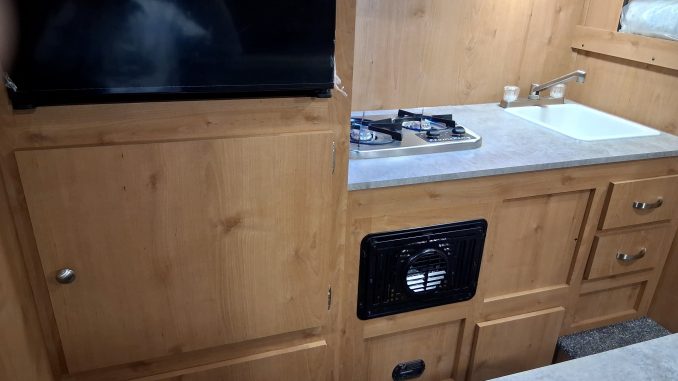
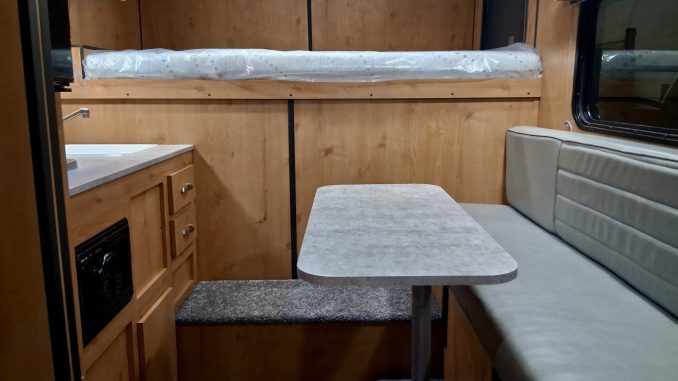
Inside, Old School uses a classic luan along with what Taulbee describes as “canoe birch,” giving the camper a warm, traditional RV appearance rather than the sterile automotive interiors becoming increasingly common in premium RVs.
The rubber EPDM roof is intentionally sloped to promote drainage and covered with a rubber roofing membrane.
It’s conventional RV construction, but that’s precisely the point. The materials are readily available, easily understood, relatively inexpensive, and repairable by practically any competent RV shop—or a handy owner.
There are no exotic proprietary composite panels or molded shells that require specialized repair techniques.
An Interesting Approach to Insulation
Old School also takes an unconventional approach to insulation.
Rather than filling the walls exclusively with conventional fiberglass or rigid foam board, the company uses reflective insulation consisting of foil-faced material with an insulating air pocket.
That air gap is important to the system’s performance.
According to Taulbee, the standard configuration provides approximately R-6 insulation. For customers wanting more thermal protection, the material can be doubled to increase the insulation value to approximately R-12 to R-13.
The insulation is glued between the studs so it remains securely positioned inside the wall.
For owners planning to camp regularly in colder climates, that upgraded insulation package could be money well spent.

Five Campers, One Simple Philosophy
Old School Campers currently offers a range of campers designed to fit everything from smaller pickups to heavy-duty trucks. The lineup consists of the 500, 550, 690, 850, and 865 models.
The philosophy behind them is refreshingly straightforward: rather than creating dozens of complicated floorplans with endless option combinations, Old School keeps the basic designs standardized.
That allows the company to build campers ahead of orders and sell them to a broader range of customers.
As Taulbee explained, once a manufacturer starts offering countless fabrics, curtains, décor packages, and custom combinations, the camper sitting in inventory inevitably becomes the one configuration the next customer doesn’t want.
So Old School keeps things simple.
The interiors use day-night shades rather than elaborate curtains and window treatments. Taulbee builds the valances himself, and buyers who want to personalize the camper can easily add their own decorative touches later.
“There’s no curtains, there’s nothing like that. Just the basics,” he said.
For buyers tired of paying for decorative features they don’t particularly want, that’s not necessarily a bad thing.

Simple Appliances, Simple Systems
The same thinking carries over to appliances.
Depending on the model, Old School uses familiar RV-industry brands including Dometic and General Electric. Larger campers can be equipped with conventional rooftop air conditioners, while smaller models can use Danby 5,000 BTU wall-mounted air-conditioning units rather than installing an oversized 15,000-BTU rooftop unit.
Ventilation follows the same philosophy. Instead of automatically installing expensive premium vent fans throughout the camper, Old School uses basic 12-volt fans where appropriate. Owners who want a MaxxAir or similar premium fan can upgrade later.
Even the camper jacks reflect the company’s value-oriented philosophy.
Old School uses Rieco-Titan manual camper jacks, which can be operated with a cordless drill using the appropriate adapter. Remote controlled electric jacks are available on the 865, but Taulbee points out that manual jacks can save buyers thousands of dollars.
That’s Old School’s philosophy in a nutshell.
If a simple solution works, why force the customer to pay for something they don’t need?

Battery Flexibility Built In
Old School takes the same flexible, no-nonsense approach with its battery system.
Rather than including a battery that may not suit every customer’s needs—or forcing buyers to pay for technology they don’t necessarily want—the camper comes pre-wired for a battery and includes a vented battery box, but the battery itself is supplied by the buyer. This allows owners to choose the battery type, capacity, and price point that best fits the way they camp.
Better yet, Old School doesn’t lock owners into traditional lead-acid technology. The camper’s WFCO battery charger features Auto-Detect technology, which automatically recognizes whether the battery installed is a conventional lead-acid or lithium battery and adjusts the charging profile accordingly.
That means an owner can keep things simple and inexpensive with a traditional battery or step up to lithium without having to replace the converter/charger.
It’s another example of Taulbee’s philosophy of building the camper around the customer rather than forcing the customer to adapt to the camper. Old School provides the infrastructure; the buyer decides how sophisticated—or how simple—the electrical system needs to be.
For a company built around affordability and simplicity, that approach makes a lot of sense.

The 850 and 865 Take Different Approaches
The differences between the company’s larger campers are particularly interesting.
The Old School 850 keeps its plumbing exceptionally simple. It uses a cassette toilet and doesn’t have conventional onboard gray or black holding tanks. Gray water is routed through an external drain fitting, much like many vintage hard-wall campers and modern pop-ups.
The larger 865 steps up to a more conventional RV plumbing arrangement with separate fresh, gray, and black tanks at 13-9-9 gallons respectively.
That’s another indication of what these campers are designed to be.
They’re not trying to carry 60 gallons of fresh water, 1,000 amp-hours of lithium batteries, and every appliance found in a luxury motorhome.
They’re designed to provide the essentials in a compact, affordable package.

East-West Beds Keep Things Compact
Old School also bucks another modern truck camper trend by making the east-west cabover bed its standard configuration.
North-south beds have become increasingly popular because they allow both occupants to enter and exit without climbing over one another, but they also require a longer cabover structure.
Taulbee prefers the shorter east-west arrangement.
Old School can build a north-south configuration if a customer insists, but it isn’t something the company actively promotes.
Again, simplicity wins.

The Number That Really Matters: Price
This is where the Old School concept gets particularly interesting.
According to Taulbee, aluminum-sided models start at approximately $13,900 for the company’s smaller campers. The 850 comes in at $15,400, while the larger 865 starts at $17,900.
Want fiberglass siding? Add about $1,000.
How about an north-south cabover? Add another $1,000.
Those prices are possible largely because Old School sells factory-direct.
There is no nationwide dealer network sitting between the factory and the buyer, and therefore no traditional dealer markup that needs to be baked into the selling price.
The tradeoff, of course, is that customers will need to travel to Indiana to pick up their camper.
For someone saving thousands—or potentially tens of thousands—of dollars compared to some competing campers, a road trip to Elkhart County might not be much of a hardship.
Indeed, customers are already traveling considerable distances to buy them.
Taulbee says Old School campers have gone to owners from coast to coast, including customers traveling between Florida and Alaska and buyers coming from the western United States.
Not bad for a small Indiana manufacturer.

There’s Something About Retro
Perhaps the most interesting thing about Old School Campers isn’t any particular specification.
It’s the philosophy.
In many ways, what Old School is doing is downright counter-revolutionary.
The truck camper industry has spent the last decade racing toward more technology, composite construction, larger electrical systems, lithium batteries, sophisticated electronics, increasingly elaborate interiors, and higher prices. Many of those advancements are genuinely useful—we’ve enthusiastically covered plenty of them here at Truck Camper Adventure.
Old School is deliberately heading the other way.
Wood framing. Aluminum siding. Simple appliances. Manual jacks. Proven construction techniques. A classic look. And a price that doesn’t require taking out a second mortgage.
Rather than asking how much technology can be packed into a truck camper, Taulbee is asking a very different question: How much of it do you really need?
That makes Old School something of a counter-revolution in the modern truck camper industry—a return to the idea that a camper can simply be a comfortable, durable, affordable place to eat, sleep, stay warm, and enjoy the outdoors.
And judging by the nostalgic appeal of these campers, Taulbee may have picked exactly the right time to go backward.
There’s also something reassuring about the fact that these campers are being built in Elkhart County, Indiana, where RV manufacturing knowledge runs deep and suppliers, components, and experienced craftspeople are concentrated within a relatively small area.
Taulbee has spent decades in that world.
Now he’s taking everything he’s learned and applying it to a camper deliberately designed to be less complicated.
Final Thoughts
We cover some extraordinary truck campers here at Truck Camper Adventure. Composite shells, massive lithium systems, sophisticated solar arrays, diesel heaters, induction cooktops, and expedition-grade construction have transformed what a truck camper can be.
But progress doesn’t always mean adding more.
Sometimes it means figuring out what you actually need and eliminating everything you don’t.
That’s what makes Old School Campers intriguing.
These campers aren’t pretending to compete with $80,000 luxury truck campers or six-figure expedition rigs. They’re offering something increasingly difficult to find: a new hard-side truck camper with traditional construction, straightforward systems, genuine retro charm, and an attainable price.
And Bob Taulbee isn’t shy about what he thinks separates his company from the rest.
“Skip the dealer, buy from the builder.”
For truck camper buyers who would rather spend their money traveling than paying for gadgets they never wanted in the first place, Old School Truck Campers might be onto something.
For more information about Old School Truck Campers or to request a quote, email the company directly at info@theoldschooltrailer.com.







Be the first to comment