





After spending a year restoring his Northern Lite truck camper, Ohio resident David Collins watched his pride and joy get ripped from his truck and flipped upside down by a low-hanging telephone cable on a West Virginia highway.
We’ve published some pretty remarkable truck camper accident stories over the years here at Truck Camper Adventure. We’ve seen campers survive rollovers, get blown off trucks by powerful winds, and suffer catastrophic damage when tie-down systems fail. But what happened to David Collins and his Northern Lite truck camper in the mountains of southern West Virginia might be the strangest accident we’ve ever encountered.
There was no rollover, no excessive speed, no dangerous off-road maneuver, and no severe weather. Collins was simply driving his 2022 Ford F-450 around a blind curve at approximately 20 to 25 mph when something struck the front of his camper.
What happened next was almost unbelievable.
A low-hanging cable caught the front of his 2007 Northern Lite 10-2 Limited Edition, ripped the camper completely off the truck, and sent it crashing onto its roof in the middle of the highway.
“I was going around a blind curve, a very tight one, at about 20, 25 miles an hour, and something slapped the front of the camper,” Collins recalled. “Next thing I know, the whole truck shook, slammed on the ground, and I looked in my mirror and there was a giant white thing in the middle of the road behind me.”
That giant white thing was his Northern Lite.
Just like that, a truck camper that Collins had spent the better part of a year rebuilding was lying upside down on a West Virginia highway.
Fortunately, Collins wasn’t injured. But the camper wasn’t nearly as lucky.
We recently spoke with Collins about this extraordinary accident, the restoration work he had completed, and what he discovered about the strength of Northern Lite’s fiberglass construction after the camper was recovered.
A Childhood Dream Finally Realized
For Collins, a Cincinnati, Ohio resident, owning a truck camper had been a lifelong dream.
His fascination began during a childhood camping trip to West Virginia when he spotted a fellow camper traveling in an older Dodge Cummins diesel pickup equipped with a truck camper. Something about the combination appealed to him, and the image stuck.
“I’ve wanted one ever since,” Collins told us.
For years, Collins made do with camping out of his station wagon. Then, about a year ago, he finally got his opportunity when a neighbor offered him a 2007 Northern Lite 10-2 Limited Edition.
The camper needed considerable work, but Collins wasn’t intimidated. He enjoys tackling mechanical projects and doing his own repairs, so the aging Northern Lite seemed like the perfect opportunity to create something special.
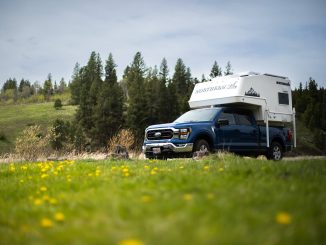
His truck was already well suited to the task: a 2022 Ford F-450 single cab equipped with a custom steel hybrid gooseneck contractor bed. The bed featured integrated storage compartments and cabinets, giving him plenty of room for tools, equipment, and camping supplies.
Collins deliberately chose a single-cab truck because he wanted something relatively maneuverable.
“I just like having the most maneuverable vehicle possible,” he explained. “I live in a pretty urban area.”
With the truck and camper finally together, Collins got busy transforming his newly acquired Northern Lite into a comfortable, off-grid adventure rig.

A Year of Hard Work and Upgrades
Like many older truck campers, the Northern Lite had suffered water intrusion over the years. The most significant damage was in the basement, where moisture had caused extensive wood rot.
Collins tackled the problem head-on.
He removed the deteriorated basement materials, replaced the damaged wooden supports, and installed new insulation. He also redesigned the rear storage compartments, eliminating the generator and creating a dedicated space for a portable solar panel that could slide into the basement when not in use.
The electrical system received a major upgrade as well.
Collins installed a massive 1,000Ah lithium battery bank, 200 watts of rooftop solar, and a modern 12-volt air conditioner. He also removed the camper’s aging refrigerator, which was no longer functioning properly, and replaced it with a more efficient portable refrigerator/freezer.
That modification freed up valuable cabinet space while reducing electrical consumption.
Additional improvements included new skylights and upgrades to the camper’s jack system.
All told, Collins estimated that he had invested more than 100 hours of his own labor into the project.
“I like doing projects like that and doing my own work,” he said.
The result was a thoroughly modernized Northern Lite that combined the proven construction of an older fiberglass camper with the electrical capabilities and conveniences of a much newer model.
And Collins and his wife were finally able to enjoy the fruits of his labor.
In May, the couple embarked on a roughly 4,000-mile adventure from Cincinnati to Michigan’s Upper Peninsula, traveling as far north as Marquette. Their dog and cat joined them for the trip.
According to Collins, the journey was fantastic. The camper performed well, the upgrades made traveling more comfortable, and the couple thoroughly enjoyed their time on the road.
After years of wanting a truck camper and months of restoration work, everything was finally coming together.
Unfortunately, that happiness wouldn’t last.
A Weekend Trip Takes a Terrible Turn
The accident occurred after Collins’ original travel plans unexpectedly changed.
He had planned to visit North Carolina and camp with a friend, but his friend was called away on military orders at the last minute. Rather than cancel his trip, Collins decided to head to southern West Virginia for a weekend of motorcycle riding.
His destination was the Hatfield-McCoy Trail System, a popular network of off-road trails winding through the Appalachian Mountains.
Collins had visited the area before and enjoyed both the riding and the opportunity to support the local economy through tourism.
The roads in this part of West Virginia are notoriously winding, with tight curves and limited visibility. Collins knew the terrain and was taking his time, traveling at approximately 20 to 25 mph as he negotiated a particularly sharp curve near Delbarton, West Virginia.
Then something struck his camper.
At first, Collins thought he might have hit a bat or some other small object.
But the impact was immediately followed by a violent jolt.
The truck shook, the suspension reacted to the sudden loss of the camper’s weight, and Collins glanced into his rearview mirror.
His Northern Lite was gone.
Instead, the large white camper was lying upside down in the middle of the road behind him.
The entire sequence had taken only a few seconds.
How a Telephone Cable Ripped Off the Camper
The culprit was a cable hanging approximately 7 feet above the road surface.
Collins initially believed it was an electrical power line, but later information indicated that it was an old telephone cable that was no longer in use.
As his truck rounded the curve, the cable struck the front of the camper and sliced into its fiberglass shell. Apparently, the cable caught the camper firmly enough that the forward motion of the F-450 generated tremendous force against the camper’s mounting system.
The result was catastrophic.
The cable pulled the Northern Lite upward and backward, tearing it loose from its tie-downs before the camper overturned and landed on its roof.
“It just ripped the FastGuns off,” Collins explained.
Of the four Torklift FastGun turnbuckles securing the camper, Collins recovered three. The fourth was never found.
The cable left a deep slice in the camper’s fiberglass front cap, providing visible evidence of where it had caught the structure.
What makes the incident particularly disturbing is that Collins had no apparent warning.
There had been no recent storm, the road was dry, and visibility around the curve was limited.
Collins speculated that a falling tree or some other disturbance might have pulled the cable down, but the exact cause remains unknown.
Even more surprising, Collins learned that the cable had reportedly struck another vehicle shortly before his accident.
According to Collins, members of a local volunteer fire department told him they had driven through the same area and that the low-hanging cable had struck and cracked their vehicle’s windshield.
The firefighters returned to their station to retrieve equipment to deal with the obstruction.
During the short interval before they returned, Collins rounded the curve in his F-450.
And his camper paid the price.

A Good Samaritan Prevents Another Accident
As frightening as the initial accident was, the situation could have become much worse.
The overturned Northern Lite was now blocking the highway just beyond a blind curve. Other motorists approaching the scene had little warning that a large camper was lying in the roadway.
Fortunately, another driver had been following Collins.
The motorist managed to stop before striking the camper, although something from the accident damaged his windshield.
Rather than simply drive away, the man stayed to help.
“He stuck around the whole night and helped stop traffic,” Collins said. “People were just flying up around that corner, and he was waving them down and stopping them before they came.”
Collins believes the man’s actions prevented additional collisions.
Without someone warning approaching traffic, another vehicle could easily have struck the overturned camper.
It’s one of the few fortunate aspects of an otherwise terrible situation.
Northern Lite’s Fiberglass Construction Put to the Test
Naturally, we were curious about how the Northern Lite survived such an extraordinary accident.
Northern Lite truck campers are well known for their two-piece molded fiberglass construction. Unlike conventional campers built with numerous exterior seams and framed wall assemblies, Northern Lite uses upper and lower fiberglass shells joined around the camper’s perimeter.
This clamshell construction has long been one of the company’s defining features.
But how would it hold up after being violently ripped off a truck and dropped onto its roof?
Surprisingly well, according to Collins.
Make no mistake, the camper suffered extensive damage. The cable had cut deeply into the front fiberglass shell, the belly band was damaged, and cracking was visible near the driver’s-side rear window.
The roof sustained the worst of the impact.
The skylight was destroyed, the roof-mounted lights were crushed, and Collins suspected that both his recently installed 12-volt air conditioner and MaxxAir fan were ruined.
But the lower fiberglass shell was another story.
“Overall, the whole bottom of the camper is not in bad shape at all,” Collins explained.
In fact, after reviewing photographs taken when the camper was turned upright at the scrapyard, Collins believed the entire lower shell could potentially be reused.
“The whole bottom could be saved if you undid the belly band, pulled the top off, and could completely reuse that bottom.”
That’s an extraordinary observation considering the violence of the accident.
Even the rear entrance door survived and remained usable, allowing Collins to access the camper and recover valuable equipment.
Of course, this doesn’t mean the Northern Lite escaped serious structural damage or that the camper was safe to reuse without extensive inspection and repair.
But the fact that much of the lower shell remained intact after such a violent separation speaks favorably of the camper’s construction.

Salvaging Thousands of Dollars in Equipment
With the camper transported to a nearby scrapyard, Collins faced the unpleasant task of salvaging whatever he could.
The scrapyard operators were accommodating and allowed him to return the following day to remove valuable components.
His first priorities included the lithium batteries and electrical equipment, particularly because he wanted to eliminate any potential fire hazard associated with damaged batteries.
He also recovered the camper’s HappiJac jacks, the recently installed jack controller, mounting brackets, windows, and other reusable parts.
Fortunately, many of these components had escaped serious damage.
And their combined value was substantial.
Collins estimated that he had approximately $25,000 invested in the camper and its upgrades, although much of the restoration labor had been his own.
By carefully salvaging usable equipment, he estimated that he recovered roughly $10,000 worth of components.
That’s certainly better than losing everything, but it did little to soften the disappointment of seeing a year’s worth of work destroyed in seconds.
The experience also left Collins facing a difficult decision.
Could the Northern Lite Be Rebuilt Again?
After seeing how much of the lower fiberglass shell had survived, Collins began wondering whether the camper might be worth restoring a second time.
It wouldn’t be easy.
The damaged roof would require extensive repairs or replacement, and the fiberglass structure would need a thorough inspection. The destroyed skylights, roof accessories, and other components would also need attention.
Still, Collins had already proven that he wasn’t afraid of a challenging restoration.
He had rebuilt the basement, redesigned the storage compartments, and modernized the electrical system. Perhaps he could do it again.
“That’s been a tough debate,” Collins admitted. “Should I go grab it and try to bring it home, or should I just say goodbye and move on to something else?”
It’s a difficult question, especially when so much personal time and effort has gone into a project.
At the time of our interview, Collins was still evaluating his options and working through the aftermath of the accident.
Whatever he decides, one thing is certain: his first Northern Lite adventure ended much sooner than he ever expected.
Could This Accident Have Been Avoided?
One of the main reasons we publish truck camper accident stories is to educate our readers.
Sometimes the lessons are obvious. Properly secure your camper. Inspect your tie-downs. Know your truck’s limitations. Avoid excessive speed on rough roads. And always pay attention to overhead clearance.
But Collins’ accident is different.
He wasn’t traveling too fast. He wasn’t driving off-road. He wasn’t crossing a questionable bridge or attempting to squeeze beneath a low overpass.
He was simply driving along a paved state highway when a cable hanging approximately 7 feet above the road caught his camper.
There was no apparent warning, and the blind curve gave him little opportunity to react.
“How do you avoid it?” Collins asked.
That’s a good question.
Truck camper owners are accustomed to watching for low branches, campground entrances, and overhead obstacles. But few would expect an abandoned communications cable to be hanging dangerously low across a public highway.
The incident also illustrates how differently an overhead obstruction can affect vehicles of various heights.
A passenger car might pass beneath a low cable without incident. A pickup truck, camper van, or truck equipped with a rooftop tent could strike it. A taller truck camper might catch it with enough force to cause catastrophic damage.
And as Collins discovered, even a heavy-duty F-450 and a properly secured camper aren’t necessarily immune to an extraordinary force applied in just the wrong place.
Final Thoughts
For David Collins, the loss of his Northern Lite was about much more than the camper itself.
It represented a childhood dream finally realized, a year of hard work, and countless hours spent transforming an aging fiberglass camper into a comfortable, modern adventure rig.
The restoration had been a labor of love.
From rebuilding the water-damaged basement to installing a massive lithium battery bank and upgrading the camper’s interior, Collins had invested considerable time and effort into making the Northern Lite his own.
And for a brief time, he and his wife were able to enjoy the rewards, including a memorable 4,000-mile journey through Michigan’s Upper Peninsula.
Then, in a matter of seconds, everything changed.
Fortunately, Collins wasn’t injured, and the quick actions of a Good Samaritan helped prevent a second accident on the winding West Virginia highway.
The incident also provided an unusual glimpse into the durability of Northern Lite’s fiberglass clamshell construction. Although the camper suffered extensive damage, the survival of much of its lower shell was impressive considering what happened.
As for Collins, his enthusiasm for truck camping appears undiminished.
During our conversation, he even mentioned the possibility of restoring an old Avion or another vintage fiberglass camper.
Considering his mechanical abilities and willingness to tackle difficult projects, we wouldn’t be surprised to see him back on the road with another truck camper before long.
We certainly hope so.
After all, someone who has dreamed of owning a truck camper since childhood deserves more than one season of adventure.
And preferably without another encounter with a low-hanging telephone cable.
Truck Camper Adventure thanks David Collins for sharing his remarkable story and photographs. We also commend the motorist who stopped to help and the emergency responders who assisted at the scene.






The Fire Department was grossly negligent in leaving the scene. Period – end of story
This is sad. We only day drive although it may have still happened.
Hope for an eventual followup on this, Did he have insurance to cover, did the utility company take responsibility? Always has been an understanding that the camper is insured as cargo when on the truck, but with all his updates, what value would insurance deem covered?
He should strongly consider legal action for negligence against the utility company or whomever is responsible for not removing that phone cable that is no longer online.