





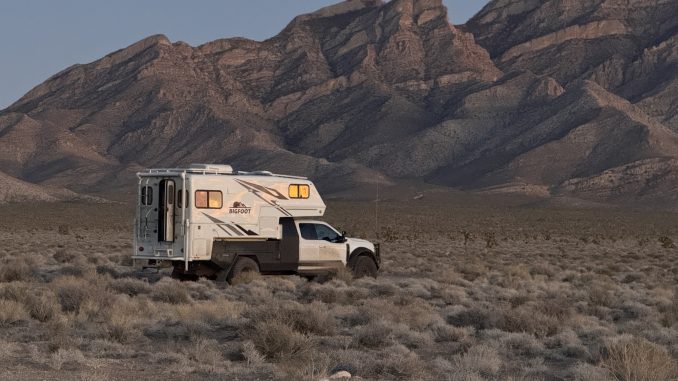
Interested in building a Ford F-550 super single monster rig using a Bigfoot camper? You’ve come to the right place. Bob Eckert has built what is probably the best looking Bigfoot rig we’ve ever seen, and we’ve seen a lot. He calls it the Dreamcatcher, an appropriate name because his rig is a dream. To learn more about this amazing build, Bob Eckert tells all.
Thanks, Bob, for talking with us. Can you tell us a little bit about yourself?
Bob Eckert: My wife Sheila and I operate four small businesses from our home in the Adirondack Park which we can manage from the road during the wintertime. So, we travel from mountain biking area to mountain biking area in our truck camper with our yellow lab Denali. One of our businesses is called New and Improved, www.newandimproved.com and focuses on training people be better creative problem solvers and helps organizations produce innovation on a more steady basis. More on the New and Improved impact on the truck camper adventuring world later. Every once in a while, Sheila kicks me out at an airport and I go off to do training or facilitate a strategic planning/product development session.
In many ways we see our rig as an innovation test platform. A number of the manufacturers we interact with are testing various products and improvements on our rig. We also own Adirondack Adventure Base www.adirondackadventurebase.com which is a glamping/camping/treehouse rental business, as well as a tree farm and maple syrup operation. We are both certified professional backcountry guides, former EMT’s and really love the freedom of travel in the southwest especially during the wintertime. We often travel with a friend in a second rig, and of course, our yellow lab Denali supervises everything and everyone.
Can you tell us about your truck camper and why you chose that particular make and model?

Bob Eckert: Our first truck camper was a Lance 825, which we purchased from a local friend who had a dealership in the Adirondacks. It was a great rig for us. We had it on an F-250 at first and then an F-350. All told, we probably logged about 100,000 miles in that rig. I do most of the driving and Sheila is a really good navigator. We always worried a little bit about the weight issues on a single rear axle, but because we go into the off-pavement backcountry so much, I was not willing to run a dually. So, we began to explore other camper models, and other rigs to carry it with. We landed on a Bigfoot 2500 10-4 model for its insulation value and the 270 degrees of windows in the back by the dinette. We really feel like we much more “outdoors” with that configuration.
Does your Bigfoot camper have anything unique or custom about it?
Bob Eckert: The “New and Improved” aspect of the Bigfoot is primarily the solar and lithium battery system that was an upgrade added by the dealership we purchased it from. 600 watts of solar and two 300 amp hour Go Power lithium batteries. We’re using Victron controllers for that and the DC-DC charging system, Our Ford F550 has a 420 amp alternator, so we get good DC-DC charging when driving. We also deleted the OEM skylight over the dinette, as the windows give plenty of light and it would be a heat waste, and roof space waste. We put an insulated door on what was supposed to be the generator closet, for extra storage. We keep our Chainsaw and some other extraction gear there instead.
Most notably, we’re an early adopter of the brand-new solar power tilting bracket system produced by www.4waysolar.com. We showcased it at the 2026 Truck Camper Adventure Rally. Mind you, we have no commercial interest in the product, but we think it’s awesome, and get a kick out of supporting small businesses. The inventor is a full-timer, working remotely as an engineer. It’s brought our solar charging capacity up by about 40 percent. It’s a boondocking game-changer.

What things do you like best about your Bigfoot camper?
Bob Eckert: We really love the 270 degrees of glass around the dinette and kitchen! In our last rig, we were always trying to find the right angle so that we could have a good view out of the dinette window. With this rig, we don’t really have to worry about that so much. So, as long as we back ourselves into a generally decent viewshed, we are good to go. And now with the 4 Way Solar brackets, no matter how we orient the truck camper we can always tilt our panels to get the most solar gain. We also like that the inside of this camper feels quieter than others that we’ve owned or been in. Likely the clam shell design and the 1.5-inch-thick insulation it goes a long way in aiding us in that regard. Since I am on the roof a lot shifting solar panel angles, it’s also nice to have a really good solid feeling roof. I also have to say that the quality of heating into the basement areas helps keep me pretty relaxed that that we will not have a freeze up when things get really cold.
I know that a lot of manufacturers brag about being four season campers, but the quality of Bigfoot’s basement insulation and heat ducting sometimes leaves a little bit to be desired. A final wonderful feature is the long central storage bin that we access from the center back of the truck camper. Most folks would use it for skis, fishing rods, paddles and such. We demount and carry our truck camper jacks there, as they must be removed for gnarly backcountry stuff, and the poor angle of departure is a truck camper killer if the rear jacks are left on when doing some of the more extreme off-roading that we do.


Can you tell us more about your Elevation Off Grid (EOG) truck? It’s a beast.
Bob Eckert: We purchased a 2024 F-550 chassis cab with a 7.3L Godzilla gas engine. I know that there are a lot of strong opinions about gas versus diesel, but we ended up not choosing a diesel because of the payload benefit we get with a gas engine. And frankly, all of my diesel mechanic friends were advising us not to get a diesel. We’ve been pretty happy with it so far although gas mileage is terrible of course. Our lifetime mileage is a cringeworthy 7.4 mpg.
We gave it to the team at Elevation Off Grid, and they modified with their pretty standard upfit. We got rid of the dualies and put 41-inch super-singles in their place, along with a liquidSpring suspension system. We’ve been really happy with it ever since. The New and Improved aspect of the EOG build is an innovation on their bumper. Because we travel in big herd animal country here, we really wanted a robust protector for the front end. We want to be able to still drive away if I hit a larger animal. So, the guys engineered and fabricated first-in-the-world incredibly robust brush/animal guard for us. I’ve never seen any brush guard this well built and this solid. And believe me, I watch. Now it is a regular SKU that you can add to your EOG builds. They really stepped up to the innovation challenge we gave them.

Can you tell us about your Bigfoot camper’s electrical system including your solar power and DC-DC charger system?
Bob Eckert: We have 600 watts of solar on the roof with a 4 way tilt system, as noted above, 600 and amp hours of lithium ion batteries from Go Power, along with a 50 amp Victron DC-DC charger and A 50 amp Victron solar charge controller. The DC-DC charger runs front to back via 4 gauge wire and connects to the battery bank via an Anderson connector. Even with all of that, I was having a hard time keeping up with charge demands until I installed the 4 way solar brackets. Now, I can run the system hard and still maintain adequate charge state.
Have you made any modifications to your truck to carry your Bigfoot camper or improve its ride?
Bob Eckert: As stated above, the LiquidSpring goes a long way towards improving the ride, and we also tried to move as much of our heavy dense cargo as far forward in the truck as is possible. Our extraction gear, for instance, is really dense stuff so we put it in the most forward storage box on our Bowen bed. That hefty bumper on the front end also helped put more weight forward. And our spare tire location is also another New and Improved innovation. More on that, when we talk about modifications to the truck bed.
Tell us about your Bowen Customs truck bed. It looks great with your rig.
Bob Eckert: We are spoting Bowen Custom’s standard camper bed and love it. Lots of storage! And, unlike many aftermarket beds, theirs is at OEM height, keeping our profile as low as possible. In our collaboration with Bowen one of the most important aspects of the bed build was to have a sizable enough garage that we could store our mountain bikes in it without having do a lot of work to make the bike smaller. So, some innovative thinking was necessary because normally Bowen stores the spare tire along with a winch and ramp to lower it to the ground in the garage area between the camper and the cab of the truck.
Your spare tire location is unique. Tell us about it?
Bob Eckert: As we experimented with various solutions to store the bikes, it became apparent that we needed to move that spare tire somewhere else. So, because we had a crew cab we decided to remove the larger part of our 60/40 back seat, behind the driver’s position. We worked with Bowen at their shop for a few days making these changes and building a custom bracket system to locate the tire safely there. We got rid of the winch and kept the ramps. I find that I can roll the tire up and down the ramps on my own with no winch system. And we still have the jump seat behind the passenger position when we are traveling with a friend.

We also built a custom bed for the dog that sits behind the driver’s position between the seat and the tire. She’s quite comfortable there. Again, the team at Bowen really stepped up to our innovation challenge. We also developed a pretty simple bracket system for the bikes. We only need to remove the front tires. The spare tire holder was also a first for Bowen and not having to share bike garage space with that gluttonous tire really makes loading and unloading the bikes a simple and quick affair.
An unexpected bonus of the large garage is that when we are in the backcountry, it’s our habit to clean up any trash that has been left in these locations. Even broken glass. So, we’ve got plenty of room to put full garbage bags back there too, which we dispose of when we return to the front country. Yes, it’s frustrating to pick up other people’s trash, but it’s still the right thing to do. And it can make a real, long-term difference.
One last innovation that I did myself was to put a bike mechanic’s bracket on one of the long cargo doors of our Bowen Customs bed. It was a simple thing to do, and now working on the bikes is a lot easier.
Can you tell us more about Elevation Off Grid’s lighting?
Bob Eckert: Absolutely. On our last rig, the F-350 (which we sold through an ad in Truck Camper Adventure to Erica Volz and Matt Baldoni, the Truck Camper Troubadour). I installed a light bar above the windshield. That was a mistake. Those things look badass, but the amount of light bounce that you get off of the hood when using them, makes that kind of lighting relatively unpractical. Elevation Off Grid’s front end lighting is really useful! I especially like the set of lights that shine out laterally at 45 degrees when I am making turns in the where there is no obvious road marking. It’s a safety game changer!
Also, what makes this rig so special is that it’s an integrated system, specifically designed for truck camping. And it looks really cool too. We get a lot of positive comments from random strangers about the build. It’s from that high frequency ‘thumbs up’ that our rig’s name was inspired. We call her “Dreamcatcher”. And she is. In our case, she’s a dream enabler!

Do you have any plans for future upgrades or modifications?
Bob Eckert: We really are pretty happy with how well this rig is serving us. Just a couple of things chewing at my innovative brain at the moment. I’ve been thinking about a deployable windmill, similar to what we see on sailboats for additional charging to the battery bank when we’re boondocking. Especially when it’s cloudy weather but also windy. We’ll see if I can partner with the right innovative company to bring that into reality.
Also, we really go very far off the pavement in this rig sometimes, on pretty rough terrain. As you like to say Mike, “happiness begins where the pavement ends,” and we are a good example of that ethic. We drive a lot of long backcountry byways, and find boondocking spots on BLM and US Forest Service roads that are rarely used because of the need for a really capable, high clearance, well-treaded 4WD vehicle. We carry quite a few backup parts to deal any kind of mechanical failure that would keep us from self-rescuing. My personal motto, coming from my Boy Scout days but modified to the reality of what we’re doing now is a version of Be Prepared: it’s “expect to self-rescue”. And we have most what we need for reasonably predictable equipment failures. I’m working the Liquid Springs folks now to develop a reasonably priced field repair kit that they too might offer as an additional SKU to their overlanding customers.
Finally, I’d like to add some kind of auxiliary fuel tank, perhaps 20 to 30 gallons. The OEM standard on this truck is 40 gallons. At 7.4 mpg, our range sucks. But if any group of minds can come up with a solution, it’s the EOG and Bowen Customs folks.

Do you have any regrets in your choices? Anything you wished that you had done differently?
Bob Eckert: We really don’t. We had 8 years in our previous rig and chatted with a lot of other owners at the Truck Camper Adventure rally and elsewhere before we finally converged on this setup. Yes, it’s very expensive build, but very reasonable compared to things like the high end “million dollar plus” overlander builds, and we are just as capable. (We’ve never once seen one of those rigs in the backcountry) But since we live in this system six months out of every year, we are selling sell off a 15 acre piece of property at Adirondack Adventure Base on which we built a chalet for my mom and dad. They are long passed, and our kids didn’t want that particular chunk, so we decided that life is short: Do what you can to enjoy it as much as possible while still learning, growing, and making a positive difference for the world.
One painful lesson: We were in regular partnership and conversation with both EOG and Bowen while all of this was being done, but the dealer from whom we bought the truck camper did the solar install with no back-and-forth consultation. I wish I had been more intimately involved in the choices that were made for the panel locations and the spaces that they used to put the batteries and other components. It could have been done a lot more efficiently than it was. So, my advice to anyone, for any rig, is to be directly involved in any after-factory upgrade that is done.

What size tires does your Elevation Off Grid Ford F-550 have?
Bob Eckert: EOG uses Goodyear’s superb 41-inch 335/80R20 LR-F tires. They’re expensive for sure. But I’ve always felt that the most vulnerable aspect of all our rigs is where the rubber meets the road. I never wanted to experience a blowout, no matter the driving circumstance, but especially at highway speed. I feel a lot more confident that these tires will decrease our risk significantly. The only thing I’m not yet really sure about is how well they will do in snow or on icy roads, as there are zero sipes in any of the treads. In the Adirondacks we know about good tires for snow and ice. I don’t think I would put a tire like this on my plow truck. But since we travel primarily in the S and SW chasing 70F for our mountain bike adventures, we only occasionally run into snow. Only when we are exploring BLM and US Forest Service roads at altitude. I have not yet been in deep mud with these tires either, so we’ll see how they do on a road like the Cottonwood Canyon Road in Utah if we get stuck there after a rainstorm. Which happened once in our F-350 with all terrain tires. It was quite the epic driving experience to get out of there. I’m looking into chains that we will carry for this truck currently.

We’ve had no need to air down as of yet. They have such a wide footprint already, and the “air down for comfort on washboard” move is not really needed with the LiquidSpring set to “sport” mode.
Where have you taken your rig thus far?
Bob Eckert: This is our second winter in this rig, and we are primarily on the West Coast and Southwest this trip and last. Typically, when we leave the Adirondacks, we joke that we are scribing a smile on the North American continent. We first head south to Asheville, North Carolina which has some of the best mountain biking in the East. As it gets cooler in October we go further south and then to Gulf of Mexico states, sleeping on beaches and mountain biking where possible and then spend the bulk of our time in the Southwest. Our daughter and her family live in Salt Lake, and our son and his family live in the Seattle area. So, we do spend a good amount of time on that axis, but they also tend to come and meet us in places like Moab and St George, Utah. The whole family, including our “in-law-kids” are former professional outdoor guides. We love camping, hiking, biking and canyoneering together.
Is there anything else you’d like to tell us about your truck camper rig that would interest our readers?
Bob Eckert: The reality of the “happiness begins where the pavement ends” ethic is that your rig is going to get scratched by brush and will be muddy. If you saw our rig at the last rally, you know what I mean. Backcountry battle scars don’t make for “pretty”. If you want to do as we do, consider the aluminum body Fords, and avoid getting it wrapped, as cool as some of those wraps look. A scratch in the paint, easy to fix, a rip on the wrap, not so much.
So far, our inclinometer records are a climb of 24 degrees and an off-camber of 16 degrees. Every rig is different in what it will be able to handle. If there was one innovation I would love to see in our sector, it would be some way to truly test what the tip over angles would be, front to back and side to side. For now, we can only go by a sense of feel. Which can be quite stressful as you might imagine.
Also, because we live in the part of the country that salts its roads in winter, and travel on dirt roads where salt is sometimes used to attract moisture and keep dust down, the biggest long-term danger to our rig is what my dad used to like call ‘ferrous cancer”: i.e. rust. I apply Fluid Film rust proofing to the underside of all of our vehicles as soon as we get them, and it really works. When I had steel bodied trucks, I also used another wax-based product in the sills and door panels called Cavity Coat. All really good stuff. Easy (but messy) to DIY. I undercoated our current rig on a big tarp in the Vegas Bay Campground on Lake Mead, right after we picked it up in Denver.
Do you have any social media channels where our readers can follow you?
Bob Eckert: Yes. Check out our YouTube Channel called Innovative Brains. We post a good deal of useful information on our Youtube channel. Most of it pertains to innovation and personal development. Some of it highlights the truck camping off roading lifestyle. Anybody interested in personal growth or better creative problem solving would find value on that site.
And of course, we have a pull through site at Adirondack Adventure Base that many in our truck camper and Overlander community are aware of, for self-contained travelers. Look at the “Adirondack Basecamp” campsite on our webpage. Few people realize how big the Adirondack Park is, it’s a full 6 million acres. Larger than the largest four national parks in the lower 48 combined. It’s a worthwhile visit.
This has been great talking to you, Bob. Thanks again for taking the time to talk with us. Do you have any final advice for our readers?
Bob Eckert: None of us should take tomorrow for granted. Sheila and I have seen too many people keep putting things off until retirement, and then have physical limitations or illnesses that prevent them from doing all the things they wished they might be able to. So, get creative. Find ways to still make a living while you find places where the pavement ends. Onward!





Be the first to comment