




Host Campers has been on the cutting-edge of RV technology from the beginning. As a matter of fact, Host was the very first truck camper company in the industry to offer large, lithium-powered off-grid options to its customers. This was back in 2018 in the infancy of the lithium battery revolution. Since then, Host has implemented several refinements to its off-grid offerings, including the switch to Go Power for all of its components.
Previously, Host used an assortment of components from Expion360, Zamp Solar, and Go Power for its off-grid systems. While these earlier systems were quite capable in their own right, it made sense to go with a single supplier for everything primarily because Go Power products are a cut above the rest. Indeed, Go Power is a leading North American brand that specializes in durable, off-grid energy systems for RVs, marine, fleet vehicles, and overlanding. Go Power makes inverters, solar panels (flexible and rigid), MPPT solar charge controllers, DC-DC chargers, batteries, and “smart” accessories, everything that a company needs to build a superb off-grid system.
Another reason for Host’s switch to Go Power exclusively is something that Host feels very strongly about—customer satisfaction. When questions or problems are encountered Go Power is always there to answer the call. Previous vendors took two or three days to respond. Obviously, this response time isn’t good enough for a company like Host that prides itself on customer service.
As a result of Go Power efficiencies—as well as improvements in battery technology—Host reduced the number of its off-grid systems from three systems to two: a powerful 600 amp hour off-grid system and a massive 1,200 amp hour system.
“Our 1,200 amp hour off-grid system can run everything in our campers,” said Randal Pozzi, Host Campers General Manager. “We still are the guys building truck campers with one of the biggest off-grid systems in the industry. The switch to Go Power has made our two off-grid systems even better.”
To say that Host’s off-grid systems have been popular with customers would be an understatement. Since the 2018 introduction to lithium power, Host has deployed nearly 500 lithium-powered off-grid options in its campers, an amazing number.
Why have Host’s lithium-powered off-grid options been so popular? The primary reason is because of the lithium battery. Simply put, the lithium battery has been a game changer for RVs. Unlike the standard lead-acid battery, which offers only 50 percent usable capacity, the lithium battery offers a nearly 100 percent usable capacity. But that’s not all. The lithium battery also weighs less than a lead-acid battery, provides a higher current output, charges faster because they can be bulked charged to 100 percent, and offers very little voltage sag. It also lasts longer than the standard lead-acid battery, is temperature resistant, doesn’t out-gas, and doesn’t require equalizing while charging.
Another reason is that Host Campers has taken the guesswork out of building its complex off-grid systems. These components—which consist of Go Power’s lithium batteries, solar panels, inverters, and monitors—not only operate seamlessly together, but they also power everything in the camper including the 15,000 BTU air conditioner. Better yet, each system is stored in the heated basement of each camper where the batteries can be protected from freezing, an important consideration for those who like to camp in winter (lithium batteries can be safely used in winter, they just can’t be charged in temperatures below 32F). Host addressed this issue two ways: by storing the lithium batteries in a heated compartment and by using lithium batteries with built-in DC heaters.

Host currently offers a 600 amp hour lithium system and a 1,200 amp hour lithium system. These off-grid systems utilize Go Power’s excellent 300 amp hour GP-ADV-LITH lithium batteries with internal Battery Management System (BMS) monitoring, DC self-heating, and Bluetooth; Go Power’s 200 watt monocrystalline solar panels; Go Power’s GP-IC 3,000 watt inverter-charger with built-in transfer relay; a Go Power DC-DC Charger, and Go Power’s GP-BMK-25 battery monitoring system that provides not only the state of charge (SOC), but also battery condition, available power, as well as charging times and discharge times based upon the current rate of draw or discharge. Both off-grid systems employ heavy-duty 4 AWG cabling for optimum performance.
Details on Host’s off-grid systems are as follows:
Host Off-Grid 600AH Package
- Two Go Power 300 amp hour Lithium Batteries (600 amp hours total)
- One Go Power Battery Monitor
- Four Go Power 200 watt solar panels (800 watts total)
- One Go Power 3,000 watt inverter-charger
- One DC-DC Charger
Host Off-Grid 1,200AH Package
- Four Go Power 300 amp hour lithium batteries (1,200 amp hours total)
- One Go Power Battery Monitor
- Four Go Power 200 watt solar panels (800 watts total on Tahoe and Cascade models); or six Go Power 200 watt solar panels (1,200 watts total on the Mammoth, Yukon, and Everest models)
- One Go Power 3,000 watt inverter-charger
- One DC-DC Charger
“Our 1,200 amp hour system is built to handle anything, but when it really gets down to it, you don’t need that big of a system for running the typical things, like the microwave, the toaster, the blender, the air dryer, the TVs,” Pozzi said. “This is because most of that stuff is either very low power or it’s short-spur stuff, and you recover from it pretty quickly with solar. But the air conditioner is the nemesis for all off-grid systems, because that’s the one thing people turn on and leave on. By having a big system, what it’s really doing is giving you the tools to manage your power easier without having to really watch it closely.”

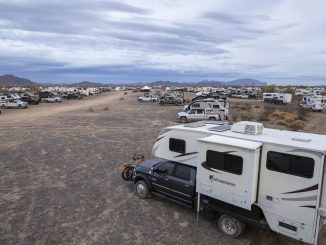
A recent experience Pozzi had at the 2025 Las Vegas SEMA show with the 1,200 amp hour system illustrates exactly how powerful Host’s 1,200 amp hour system truly is. Pozzi went inside the display camper to catch up on emails and turned the air conditioner on, but forgot to turn the air conditioner off after he was finished for the day.
“I turned the air conditioner on at 1pm, and when I left that night I forgot to turn it off,” he said. “So I went back at 8:30am, which was 19 hours from when I turned it on. The air conditioner was still running. The first thing I did is looked at my battery monitor, and I still had 695 amp hours in my batteries. If I had our smaller, 600 amp hour system, which is huge for most people, I would have dead batteries. But I didn’t. I still had more than half capacity. The system works that well. That’s the nice thing about the system. It functions well, and you can make those little mistakes, like I did, like forgetting to turn it off, and it didn’t kill me. That’s really what the big systems are about. That’s what’s so nice about the big off-grid system, it just gives you the tools to do what you want to do.”
Like the lithium battery, solar power has made an enormous impact on how we operate our truck campers off-grid. Today’s campers enjoy total independence and are no longer tethered to RV parks and campgrounds for power. Yet, its important to understand that solar power doesn’t run a thing in your camper. We often hear people ask, ‘what can I run with my solar panels?’ The answer is nothing. Appliances run off of batteries, the solar panels are simply a way to recharge your batteries, but the more solar panels you have in your system the better.
Solar power, of course, is dependent on one thing—the sun. Solar power works great when the sun is out, but not so great when obscured by clouds. This is why its important to always monitor the skies before using high amperage appliances like the air conditioner and the induction cooktop. The time of day and the battery state of charge are important things to keep an eye on with your battery monitor too. Fortunately, the size of Host’s off-grid systems can help mitigate any problems with the weather and over use.
After his recent experience at SEMA, Pozzi agrees.
“When the air conditioner in our camper first kicks on, the amp usage will jump up to 120 amps then pretty quickly it will back down to about 75 amps. Then you’re pulling in several amps for your refrigerator, and the inverter itself is pulling a couple of amps, even doing nothing. Then you have your lights on and stuff. Let’s say you’re pulling 80 amps an hour on your system. But at the same time you’re putting back about 9 amps per panel on a sunny day, which is approximately 55 amps. Well, you’re still running at a 25 amp deficit. But even with a 25 amp deficit, you can go a long time with a 1,200 amp hour battery bank before you’re running out of power,” he said.
There’s no doubt about it, Host’s off-grid systems are a perfect compliment to the company’s lineup of luxury truck campers, which feature as many as three slide-outs and amenities like reclining seats, washers and dryers, full-size dry-baths, and king-size beds. Host’s current catalog consists of five, full-size models: Tahoe SB 9.5 (short-bed), Cascade 10.5, Everest 11.6, the Yukon 11.6, and the Mammoth 11.6, the company’s most popular camper.
“Chevrolet builds a lot more cars than Ferrari, but I’d still rather have a Ferrari. That’s kind of how we feel about us. There are guys who make a lot more campers, but nobody makes a better one than Host. We’re usually the guy who’s leading the way with cutting edge designs and features. Our Off-Grid Systems is another fine example of that,” Pozzi said.
To learn more about Host Campers or to get a quote, email the company directly at rpozzi@hostcampers.com.


Wish Host and Gopower would do an install to show the install of the equipment in that compartment. My grandson could not fit in there to do what is needed.. Lots of us are asking that question. Jim.