



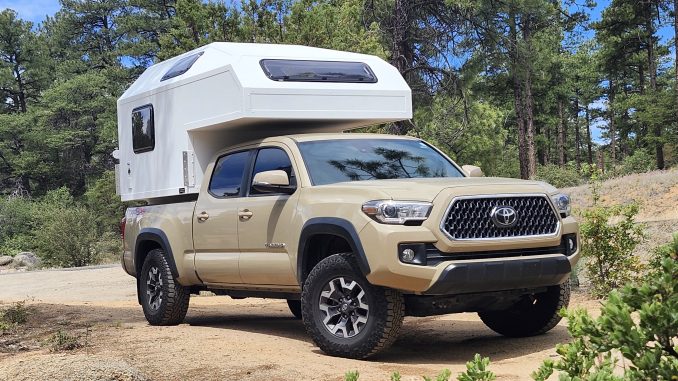
When AT Overland unveiled its full-size Aterra slide-in camper in 2025, one question immediately started echoing through the overlanding community:
“What about us mid-size truck owners?”
At the 2026 Overland Expo Pacific Northwest, AT Overland founder Mario Donovan finally had the answer.
Standing inside the company’s brand-new Aterra mid-size slide-in camper, Donovan smiled as he explained that the new model wasn’t simply a smaller version of its bigger sibling—it was engineered from the ground up to maximize every inch of space while respecting the payload limitations of today’s midsize pickups.
“We’re dealing with lighter payloads in mid-size trucks,” Donovan explained. “So we had to design something that still feels spacious while keeping the weight under control.”
Mission accomplished.
Big Camper Comfort in a Mid-Size Package
Designed around a 6-foot camper body that can also fit 5-foot beds with the tailgate down or removed, the Aterra is aimed squarely at mid-size Tacoma, Colorado, Ranger, Frontier, and similar truck owners.
The camper starts at just 757 pounds in shell form and weighs 1,049 pounds as equipped in the fully-optioned display model AT Overland brought to the show. Even more impressive, every camper is individually weighed before delivery, eliminating the guesswork that often comes with published “dry weight” numbers.
“It’s the actual weight,” Donovan emphasized.
For truck owners trying to stay within their payload ratings, that’s a refreshing level of transparency.

Honeycomb Construction: Aerospace Meets Overlanding
Like every Aterra camper, the mid-size version is built entirely from AT Overland’s signature honeycomb composite panels rather than conventional foam-core construction.
Donovan demonstrated the difference with two sample panels.
Traditional foam panels eventually compress, crack, and delaminate after repeated impacts. The honeycomb panel, by comparison, contains 318 individual 8mm cells per square foot, allowing each cell to act like its own tiny spring.
Then he did something that stopped everyone nearby.
He grabbed a massive wrench and slammed it into the camper’s sidewall. No dent. No crack. No damage.
“That’s aerospace material,” he laughed.
The four season composite construction also provides excellent insulation, delivering approximately R-5 walls and R-6 ceiling insulation, while virtually eliminating thermal bridging for genuine four-season capability.
The exterior receives a UV-resistant polyurea coating that won’t fade to the familiar chalky gray seen on many bedliner finishes after years in the sun.
Engineering Every Pound
One thing becomes immediately obvious while touring the camper: Nothing is placed randomly.
Donovan explained that AT Overland targets a 60/40 weight distribution, placing roughly 60 percent of the weight forward of the rear axle.
Heavy components—including the electrical system, water tank, and refrigerator—are positioned with center of gravity in mind.
“We don’t put cabinets up top,” Donovan said. “Cabinets increase your center of gravity.”
Instead, upper storage is replaced with AT Overland’s modular Step 22 storage bag system, reducing weight high in the camper while keeping gear organized and accessible.
It’s thoughtful engineering that serious off-road travelers will appreciate.
A Dinette That Actually Works
Compact campers often force owners into awkward layouts where converting the bed means blocking access to everything else.
AT Overland tackled the problem differently. The Aterra features a center dinette, allowing two people to comfortably sit facing each other.
A cleverly designed bamboo countertop doubles as a removable table, while an optional Lagun swivel mount creates a flexible dining or workstation.
Need more prep space? Simply flip up the extension countertop.
Need to sleep? The massive cabover bed slides outward to become an impressive 74 inches wide—four inches wider than a residential queen mattress—while maintaining the same 80-inch length.
Even better, the dinette doesn’t become an obstacle. The seats transform into convenient steps for climbing into bed instead of getting buried underneath it like traditional front-dinette designs.
For anyone who’s wrestled with cramped truck campers before, it’s one of those “Why didn’t someone think of this sooner?” moments.


Smart Systems Throughout
Power comes standard from a 105-amp hour Lion Energy lithium battery, paired with a Redarc Manager30 charging system capable of managing truck alternator charging, shore power, and solar input.
Owners wanting serious off-grid capability can upgrade all the way to 640 amp hours of lithium capacity, making features like the optional Nomadic X2 DC air conditioner practical for extended adventures.
Other available upgrades include:
- Truma VarioHeat furnace
- National Luna refrigerator/freezer
- Stainless sink and 12-gallon water system
- External hot water shower
- Composting or sealing toilet options
- Starlink Mini roof mount
- Fiamma awnings
- Interior and exterior MOLLE storage systems
Even the 6L electric water heater was chosen specifically because it fit the compact layout without sacrificing storage.
One of the Cleverest Camper Mounting Systems We’ve Seen
Perhaps the biggest surprise wasn’t inside the camper at all. Instead of traditional turnbuckles or tie-down straps, AT Overland developed an entirely new mounting system.
Steel plates bolt directly to the factory bed mounting locations—no drilling required. As the camper is lowered into the truck bed, tapered guides automatically center it into position every time.
Four internal bolts secure everything from inside the camper. The benefits to serious overlanders are significant. No external turnbuckles. No unsightly exposed hardware. No large clearance gaps between the camper and truck bed.
Better yet, the proprietary system allows the camper walls to sit just a half-inch from the bed rails, maximizing interior width while eliminating outriggers that could snag on tight trails.
For serious off-road use, it’s an elegant solution.

Built to Grow With You
One of the Aterra’s biggest strengths is its modular philosophy. Buyers can start with a lightweight shell for $30,500 and build it out over time using factory-designed bolt-in modules.
Want to handle your own cabinetry? Go for it.
Prefer AT Overland’s professionally engineered components? Add them whenever you’re ready.
That flexibility makes the Aterra appealing to everyone from hardcore DIY builders to travelers looking for a turnkey expedition camper.
Final Thoughts
Walking away from the AT Overland display, one thing became clear. The new Aterra mid-size slide-in isn’t simply a downsized camper. It’s a carefully engineered expedition platform that borrows lessons from aerospace construction, automotive engineering, and years of overland experience.
From its impact-resistant honeycomb shell to its exceptionally low center of gravity, modular interior, innovative mounting system, and payload-conscious design, nearly every detail has been thoughtfully considered.
For mid-size truck owners who have been waiting for a truly capable hard-sided expedition camper that doesn’t overwhelm their truck, the wait may finally be over.
And if Mario Donovan’s enthusiasm at the 2026 Overland Expo Pacific Northwest was any indication, AT Overland believes this little camper is going to make a very big impression.
For more information about this and other AT Overland campers or to get a quote, contact the company directly at mario@atoverland.com.





Be the first to comment